At a time when political rhetoric can put longstanding international relationships under strain, cooperation between professionals and public organisations on both sides of the Atlantic matters more than ever.
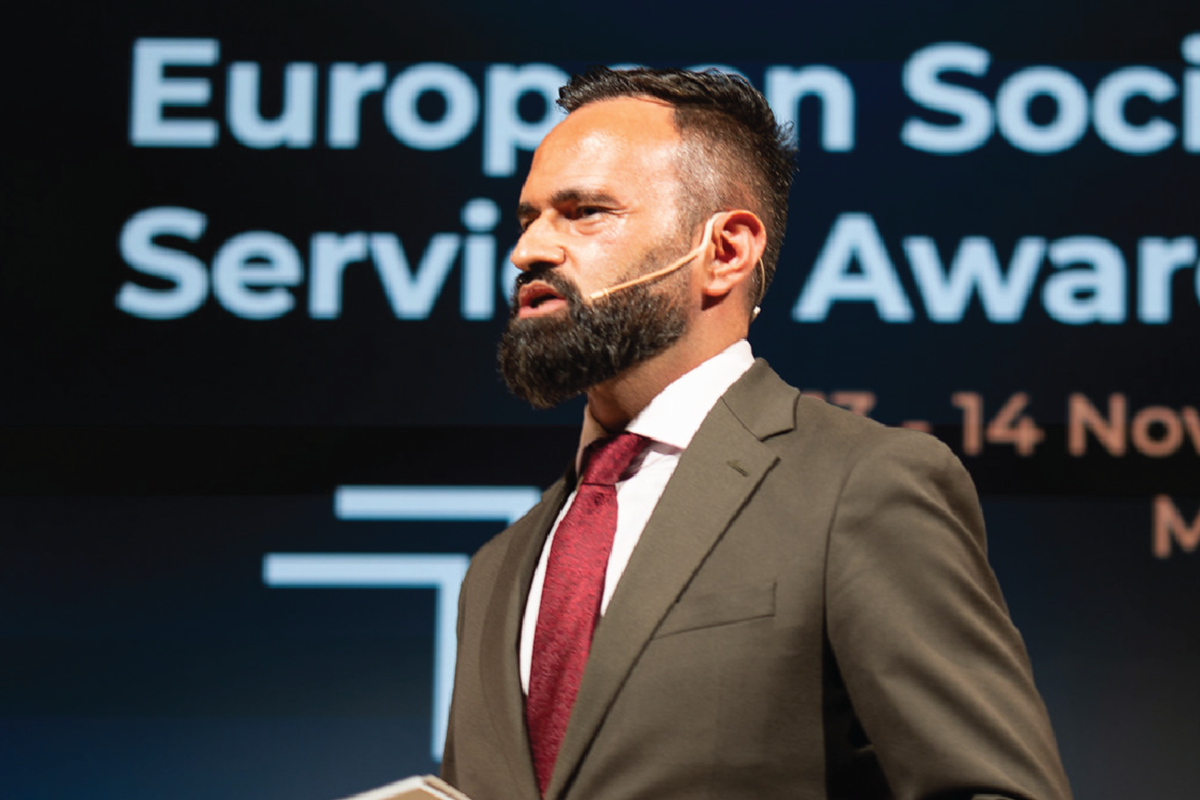
That is why I was particularly pleased to join the American Public Human Services Association (APHSA) at its ISM Education Conference & Expo in Spokane, Washington, and share a panel with APHSA President and CEO Reggie Bicha on the future of child welfare on 28 September. Our participation together was more than an opportunity to exchange ideas about technology. It demonstrated the value of a transatlantic partnership between two networks united by a common purpose: improving public social and human services and, ultimately, people’s lives.
The European Social Network (ESN) brings together 200 member organisations from 38 European countries, representing public authorities and organisations responsible for social services across all government levels. APHSA brings together state and local human services agencies across the United States. Our systems, terminology, legal frameworks, and institutional arrangements differ. But the challenges facing our members are remarkably similar.
Shared ambitions, shared challenges, innovative solutions
Child welfare illustrates this particularly well.
On both sides of the Atlantic, our fundamental ambition is the same: protecting children from harm, families before difficulties become crises, and ultimately enabling children to thrive. However, translating those ambitions into practice remains challenging.
In Europe, despite a strong policy commitment to family-based care, more than 290,000 children are still living in residential care. An ESN survey in 2024 found that 80% of participating ESN Members reported shortages of foster care. Social services are therefore exploring a range of responses: from family conferences in the Netherlands to mobilise kinship carers, to further professionalising foster care in France.
But perhaps the most important lesson we share is that successful child welfare cannot begin at the point of crisis.
Prevention means strengthening the conditions in which families live. The European Child Guarantee promotes access for disadvantaged children to services such as early childhood education and care, school meals and leisure activities. Cities such as Madrid are developing practical approaches including a family card that help families meet everyday needs without stigma, while services in Belgium and Germany bring social and family support closer to parents through home visits and maternity services.
Technology can strengthen this preventive approach, but only when we remember that technology is a means, not the objective.
At ISM, I highlighted how digitalisation can help social services identify emerging needs, understand which communities may require additional investment, bring information from different services together, and monitor whether support is improving outcomes for families. For example, Ireland’s Child and Family Agency of Ireland (TUSLA), has developed a national case management system providing professionals with a ‘single view of the child’. Barcelona is developing a platform giving professionals a 360-degree view across more than 25 social services and 50 resources. But one of the most important lessons from Barcelona is not technological at all: staff at all levels have been involved from the beginning in identifying needs, designing the system, testing it, and implementing it.
This strongly resonated with a point Reggie made in our discussion: we need to listen to our staff and involve them from the start. This is an important area of convergence between our experiences. Successful digital transformation is as much about people, professional practice, and organisational culture as it is about technology. The people who deliver services every day need to help shape the tools they will ultimately use to make them effective in practice.
We found similar common ground when discussing artificial intelligence (AI). European cities are already using AI to analyse information, identify needs, and support professional decision-making. But experience also provides powerful warnings about what happens when technology is used without sufficient safeguards.
Here again, Reggie and I emphasised a shared principle: AI can support human judgement, but it cannot replace it. Decisions affecting a child or family cannot simply be delegated to an algorithm. Social workers and other human services professionals bring empathy, professional judgement, and an understanding of people’s lived experience. Technology should give them better information and more time to exercise those strengths, rather than be a substitute for them.
This convergence is precisely why transatlantic cooperation is so valuable. The partnership between ESN and APHSA creates a bridge between public social and human services leaders facing many of the same questions: How do we move from crisis response towards prevention? How do we integrate services around people rather than administrations? How do we use data responsibly? How do we bring our workforce with us through technological change? And how do we ensure that digital transformation strengthens rather than diminishes human relationships?
Keeping people at the heart of services
My central message at ISM was that children and family services should be designed from a person-centred perspective, rather than around individual services. Families should not have to knock on multiple doors and navigate fragmented systems themselves. Services should work in partnership from the outset, with a coordinating professional or agency and technology supporting that collaboration.
That principle can also describe our transatlantic relationship.
The challenges confronting public social and human services are too important for us to address them in isolation. Through ESN and APHSA, we have an opportunity to deepen a transatlantic community of public social and human services — one in which we learn from each other, challenge each other and turn shared principles into better practice.
As our conversation at ISM demonstrated, many of the values guiding our work — prevention, partnership, professional judgement and putting people first — are shared.
Our systems may be separated by an ocean. Our mission is not.