
Recommendation
Croatia should further expand community services for children, people with disabilities, and older people, ensuring their financial stability, efficiency, and adaptability to demographic changes, to improve access to social support across the country.
Social Services Legislation
Right to access social services
✅ The Social Welfare Act stipulates who has the right to receive certain social services and under which conditions.
Definition of social services
✅ Article 70 of the Social Welfare Act defines social services as activities aimed at identifying, preventing, and solving the problems and difficulties of individuals and families and improving the quality of their lives in the community.
National social services catalogue
✅ The governmental e-citizens portal contains a catalogue of information on rights and services from the social welfare system. Information on benefits and services is also available on the Ministry of Labour, Pension System, Family and Social Policy’s website, and a list of social services and how they are delivered is published on the Croatian Institute for Social Welfare’s website.
National social services strategic plan
✅ The National Plan for the Development of Social Services 2021-2027 focuses on the inclusion of socially vulnerable groups by setting two priorities in social services development:
- Availability and innovation of social services at the local level. The focus is on addressing the needs of socially vulnerable groups, supporting community life, and preventing social exclusion. Foster care is promoted as an effective means to ensure the right to live in a family.
- High-quality and sustainable social services development. The focus is on enhancing social services management and increasing the capacities of social services providers.
Responsibilities of national, regional, and local authorities
According to the Social Welfare Act and the Regulations on Criteria for the Provision of Social Services, responsibilities concerning social services are distributed as follows.
Financing:
- The Ministry of Labour, Pension System, Family and Social Policy (‘the Labour Ministry’) sets the cost of social services, except for private service providers with no contract with the Labour Ministry, who set their own prices on the market.
- Local and regional authorities are required to allocate funds for social care, including food distribution in soup kitchens, homeless shelters, and material assistance. If municipalities cannot fund these services, regional governments and the City of Zagreb contribute based on their capacities.
- Regional governments and the City of Zagreb also finance decentralised homes for older people.
Provision and planning:
- The Labour Ministry approves service provision criteria for services provided by the Croatian Institute for Social Welfare and the Family Centre, while regional governments and the city of Zagreb do the same for other social service providers (care homes, home care providers, associations, religious communities, and individual practitioners).
- The Labour Ministry maintains a service provider registry. Regional governments and the City of Zagreb check at least once a year whether licensed providers meet the criteria. These entities also establish a Council for Social Welfare to plan and develop social services, analyse capacity and needs, and set development goals, particularly for at-risk groups.
- Regional governments and the City of Zagreb have the power to assess all providers, except the Croatian Institute for Social Welfare and the Family Centre.
- The Croatian Institute for Social Welfare began working on 1 January 2023 and has consolidated former social welfare centres to have standardised procedures, professional supervision, and support services in all centres.
- The Family Centre was founded as an independent institution.
Inspection:
- Inspection of services is carried out by Ministry inspectors.
Social Services Expenditure
As of 1 January 2024, Croatia's population was 3,861,967 people (Source: Eurostat). That same year, the country’s gross domestic product (at market prices) reached €85,609.8 million (Source: Eurostat).
Croatia’s 2024 total public expenditure at national, regional, and local levels was €933,992,829, as follows:
- National level: €855,696,757, of which:
- Social services: €676,998,866 (including personal disability allowance, care assistance, inclusive allowance, parent carer allowance, and carer allowance).
- State homes: €178,697,891 (including costs for capital investments from the state budget and capital investments from EU funds).
- Regional and local level: €78,296,072 (based on data collected from local authorities, all 21 counties) (Source: Ministry of Labour, Pension System, Family and Social Policy; City of Zagreb – confidential).
Social Services Coverage
Social Services Workforce
As of 31 December 2024, 1,753 social workers were employed in the social welfare system. Of these:
- 1,400 were employed in the Croatian Institute for Social Welfare.
- 353 were employed as social workers in social welfare homes (95 of them are employed in educational positions working mainly in social welfare homes for children and youth and family centres).
The number of social workers employed by private employers is not available.
As of 31 December 2024, 2,241 professionals were employed in public social services:
- 1,400 social workers (mentioned above).
- 841 other workers (lawyers, psychologists, and social pedagogues) (Source: Ministry of Labour, Pension System, Family and Social Policy – confidential).
Long-term Care Services for Older People
Population aged 65+
As of 1 January 2024, 23% of the population or 889,000 people were aged 65 and over (Source: Eurostat).
In 2023, according to a World Bank analysis on long-term care provision in Croatia, there were 359,218 people with long-term care needs:
- Older people (65+): 228,749.
- People of working age: 130,469.
In 2024, 91,392 people aged 65+ received long-term care through the social welfare system, including:
- Assistance and care allowance: 11,692.
- Personal disability allowance: 4,557.
- Inclusive allowance: 68,927.
- Day care: 38.
- Supported housing: 92.
- Home care: 1,891.
- State accommodation: 2,144.
- Foster care for people with disabilities aged 65+: 561.
- Foster care for older people: 1,092.
- Users aged 65+ with officially recognised caregivers: 398.
It is important to note that a single user may receive several benefits and services simultaneously.
Long-term care can be put in place immediately (urgent accommodation) or it can take several years (from 1 to 10 years, depending on the region in Croatia) (Source: Ministry of Labour, Pension System, Family and Social Policy – confidential).
Residential care facilities
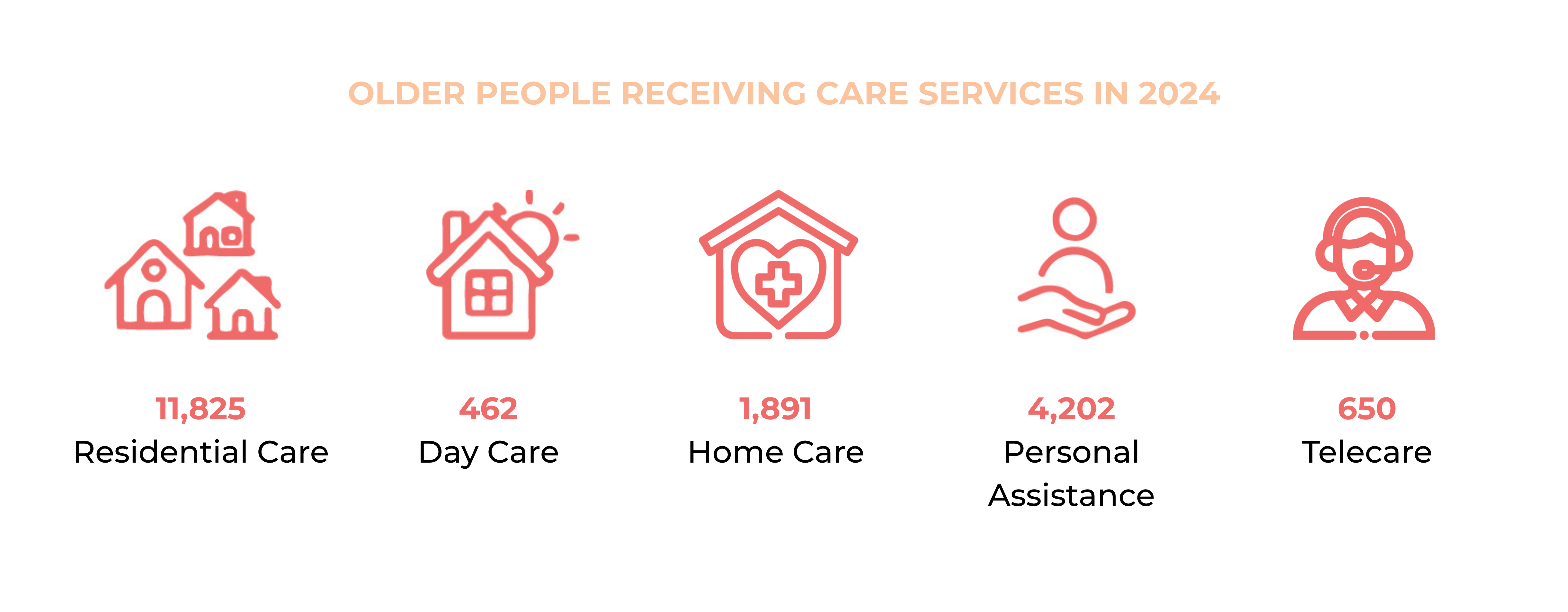
In 2024, 11,825 older people were living in publicly funded residential care facilities, of whom:
- Through the Labour Ministry:
- 969 in state homes.
- 1,095 in decentralised homes (under counties’ responsibility).
- 20 in social welfare homes established by non-governmental organisations.
- 56 with foster families.
- 58 in social welfare homes established by other legal entities.
- Through local governments: 9,627 (Source: Ministry of Labour, Pension System, Family and Social Policy; City of Zagreb – confidential).
Day care centres
In 2024, 74 providers were registered as day care providers in the social services providers registry, and 476 publicly co-financed places were available for day care services for older people. The Labour Ministry signed contracts with ten of these providers to deliver day care services, offering 221 places (including 149 in decentralised homes). Local authorities guaranteed 106 places.
In 2024, 462 older people received day care, of whom:
- Through the Labour Ministry:
- 5 in state homes.
- 17 in decentralised homes.
- 9 in social welfare homes established by non-government entities.
- 7 in social welfare homes established by other legal entities.
- Through local governments: 424 (Source: Ministry of Labour, Pension System, Family and Social Policy; City of Zagreb – confidential).
Home care services
As of 31 December 2024, 1,891 older people received home care services.
Regional offices of the Croatian Institute for Social Welfare assess the need for home assistance weekly. It is estimated that the state pays for an average of 18 hours per user per month, but some may receive a set number of hours a year (Source: Ministry of Labour, Pension System, Family and Social Policy).
Personal assistants
As of 31 December 2024, 1,524 older people received personal assistance (Source: Ministry of Labour, Pension System, Family and Social Policy).
Telecare services
In 2024, 650 older people received telecare services, of whom:
- Through the Labour Ministry: 466.
- Through local authorities: 184 (Source: Ministry of Labour, Pension System, Family and Social Policy; City of Zagreb – confidential).
Plans
The Operational Plan for the Development of Integrated Long-term Care 2025-2030 plans non-institutional services and additional accommodation capacities for those in need. The Plan consists of six key areas:
- Needs assessment in long-term care.
- Policy development and governance of the long-term care system.
- Provision of long-term care services.
- Development of human resources in long-term care.
- Financing of the long-term care system.
- Monitoring and evaluation.
Long-term Care Services for Adults with Disabilities
Population aged 18+ with disabilities
As of 19 May 2025, 287,407 people with disabilities aged 18-64 were registered in the persons with disabilities registry as having one or more impairments (Source: Croatian Institute of Public Health).
As of 31 December 2024, 184,809 people with disabilities aged 18-64 received accommodation and social benefits, as follows:
- Personal disability allowance: 7,751.
- Assistance and care allowance: 8,297.
- Inclusive allowance: 158,970.
- Care under parent caregiver status: 3,725.
- Care under caregiver status: 528.
- Home care services: 1,305.
- State accommodation: 4,233 (Source: Ministry of Labour, Pension System, Family and Social Policy).
The Personal Assistance Act and the Inclusive Allowance Act require urgent procedures for recognising rights. The Croatian Institute for Social Welfare must issue a decision within 30 days of a valid request or ex officio initiation if an expert examination is needed. However, high request volumes are causing longer wait times than the legal limit (Source: Ministry of Labour, Pension System, Family and Social Policy – confidential).
Residential care facilities
In 2024, there were 2,957 places available at publicly funded residential care facilities for adults with disabilities, 2,493 of which were provided by providers with whom the Labour Ministry signed contracts for service provision.
As of 31 May 2025, 4,110 adults with disabilities lived in publicly funded residential care facilities:
- 3,563 in state accommodation.
- 547 in supported housing (Source: Ministry of Labour, Pension System, Family and Social Policy – confidential).
Day care centres
As of 31 December 2024, 1,455 people with disabilities aged 18-64 received day care (Source: Ministry of Labour, Pension System, Family and Social Policy).
Home care services
As of 31 December 2024, 1,305 people with disabilities aged 18-64 received home care services. On average, they received 18 hours of home care per month (Source: Ministry of Labour, Pension System, Family and Social Policy).
Personal assistants
As of 31 December 2024, 3,390 people with disabilities aged 18-64 had a personal assistant (Source: Ministry of Labour, Pension System, Family and Social Policy).
Telecare services
In 2023, 422 people with disabilities received telecare under a remote care programme implemented by the Croatian Association of Multiple Sclerosis Societies and funded by the Labour Ministry (Source: Ministry of Labour, Pension System, Family and Social Policy – confidential). Their age, however, was unclear.
Reforms
The Personal Assistance Act, which entered into force on 1 July 2023, made social services a legally guaranteed right for people with disabilities, providing daily assistance with activities they cannot perform independently and enabling greater independence and community participation. Financed now from the state budget, this resulted in an increase in the number of both service providers and users compared to the previous period, when the service was provided only by providers financed through ESF projects.
In 2024, the Social Welfare Act was amended to expand the number of people who can be granted caregiver status and increase compensation.
The Inclusive Allowance Act, which entered into force on 1 January 2024, combines four allowances (personal disability allowance, assistance and care allowance, child allowance, and financial aid for unemployed people with disabilities) into a single inclusive allowance for people with disabilities, classified into five levels based on actual impairment. This reform ensures fairer distribution, greater transparency, and significantly higher benefits. A key improvement is that only one expert report is required to access any right, replacing the previous need to submit the same documents to multiple systems.
Child Protection
In 2024, 412 procedures for urgent separation and placement of a child outside the family were initiated.
As of 31 December 2024, 3,601 children were placed in alternative care. Of these:
- 1,928 were placed in family-based care (foster or kinship care).
- 1,284 were placed in residential care.
- 389 lived in supported housing, which is implemented in separate residential units. These children were either:
- Without adequate parental care: 324.
- Displaying behavioural problems: 61.
- Victims of human trafficking: 1.
- Unaccompanied children: 3.
Additionally, 427 unaccompanied children received accommodation and 126 young people aged 18-26 received accommodation for young people with disabilities who regularly attend services for people with developmental disabilities and young adults who require housing support (Source: Ministry of Labour, Pension System, Family and Social Policy).
Domestic Violence Support Services
Women experiencing domestic violence
In 2024, 12,252 domestic violence offences were recorded under the provisions of the Act on Protection from Domestic Violence. The number of female victims was 10,124, 2,285 of which were under the age of 18 (Source: Ministry of Labour, Pension System, Family and Social Policy).
Women receiving support from domestic violence support services
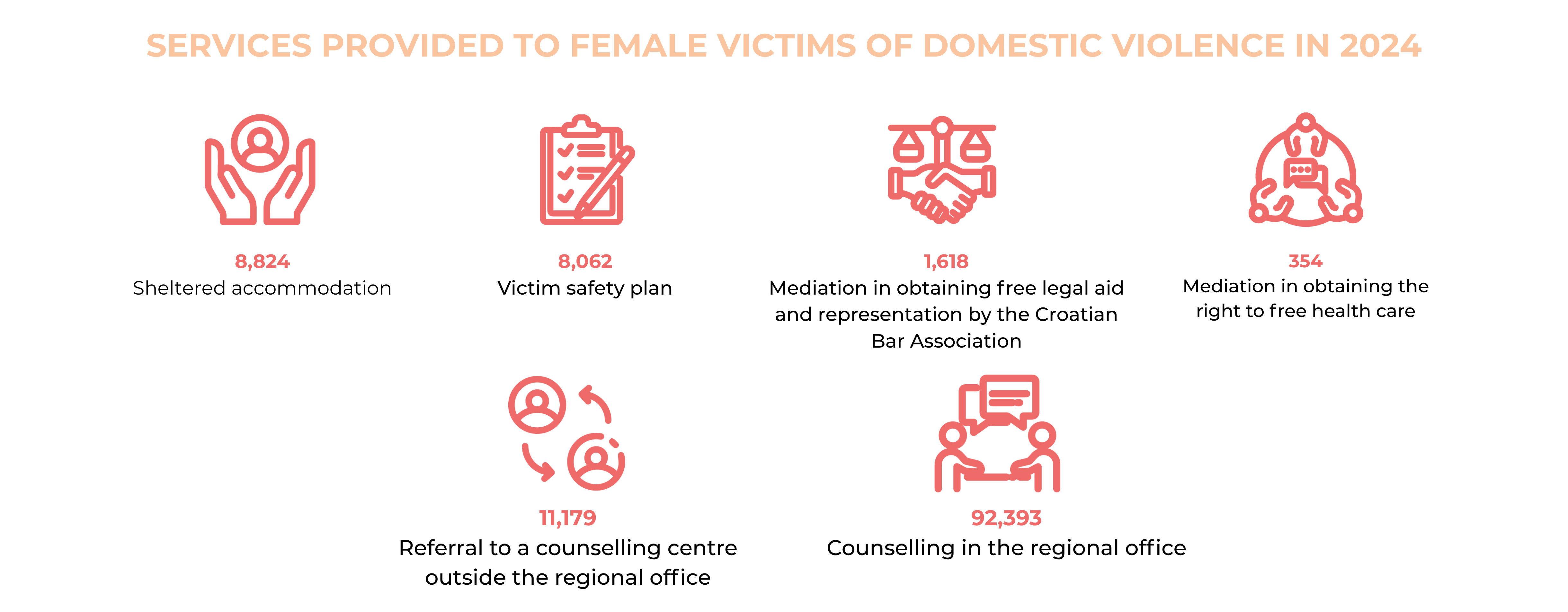
In 2024, female victims of domestic violence were provided a range of services, including:
- Sheltered accommodation: 8,824.
- Victim safety plan: 8,062.
- Mediation in obtaining free legal aid and representation by the Croatian Bar Association: 1,618.
- Mediation in obtaining the right to free health care: 354.
- Referral to a counselling centre outside the regional office: 5,323.
- Counselling in the regional office: 8,752 (Source: Ministry of Labour, Pension System, Family and Social Policy).
Emergency accommodation centres
In 2024, 26 shelters for victims of violence operated across Croatia, providing 402 places. As of 30 April 2025, the occupancy rate was 49% (Source: Ministry of Labour, Pension System, Family and Social Policy – confidential).
Reforms
The Social Welfare Act introduced the right for victims of domestic violence who have been granted crisis accommodation to access 50% of the Guaranteed Minimum Benefit. In 2025, this was amended to provide the right to 100% of this benefit and to introduce psychosocial counselling services without a time limit for victims of domestic violence and victims of gender-based violence.
Minimum Income Schemes
According to the Social Welfare Act, people in need can access the following benefits:
- Guaranteed Minimum Benefit: a cash benefit granted to single persons or households who do not have sufficient means to meet basic living needs. The benefit amount depends on the number of household members, their personal characteristics, and total income.
- Housing Allowance: an allowance available to the beneficiaries of the Guaranteed Minimum Benefit, except for homeless people in shelters, people in crisis situations (victims of domestic violence, victims of human trafficking), or people who are already provided with institutional care or supported housing.
- Allowance for Vulnerable Energy Buyers: a benefit intended for single persons or households that meet special conditions according to energy sector regulations. This benefit co-finances the costs of electricity, gas, and/or heat energy.
Additionally, according to the National Benefit for Older People Act, people over the age of 65 who are neither pension beneficiaries nor participants in mandatory pension insurance can access, under certain conditions, the National Benefit for Older People.
In December 2024, the following number of people received the following social benefits:
- Guaranteed Minimum Benefit: 44,286.
- Allowance for Vulnerable Energy Buyers: 101,432.
- National Benefit for Older People: 17,849 (Source: Ministry of Labour, Pension System, Family and Social Policy).
Plans
The National Plan for the Fight against Poverty and Social Exclusion 2021-2027 sets priorities and measures to effectively reduce poverty and social exclusion and improve the everyday life of people at risk of severe material deprivation.
Housing and Homelessness Support
Housing support allowances
According to the Social Welfare Act, beneficiaries of the Guaranteed Minimum Benefit are entitled to the Housing Allowance, which provides compensation to cover housing costs. This allowance is not available to homeless people in shelters, people in crisis accommodation (victims of domestic violence, victims of human trafficking), or people who are already provided with institutional care or organised housing. The compensation for housing costs refers to rent, utility fees, heating costs, water services, and costs incurred due to work to increase the building's energy efficiency.
Homeless people
In 2023, 635 homeless people received accommodation, shelter, and overnight stay services. Of these, 285 had addiction problems, 185 had psychological difficulties, and 30 had partial disabilities (Ministry of Labour, Pension System, Family and Social Policy – confidential).
Each year, the Labour Ministry, in cooperation with counties, large cities, and municipalities, develops a Plan for the Care of the Homeless in Winter Conditions. The Plan for 2024/2025 indicates a total capacity for accommodation and organised housing services of 410, with an additional capacity for accommodation of 242 (Source: Ministry of Labour, Pension System, Family and Social Policy).
Reforms
In 2025, the Social Welfare Act was amended to grant homeless people the right to 100% of the Guaranteed Minimum Benefit even if placed in a shelter or organised housing (previously, they were entitled to 50% of the amount).
Plans
In 2025, Croatia adopted its first National Housing Policy Plan until 2030 aimed at ensuring affordable and sustainable housing and providing enough place for housing.