
Recommendation
Cyprus can transform its social welfare system by transferring carefully selected responsibilities from the central administration to district and municipal level bodies, allowing decisions to be taken close to the people they affect. The goal is to weave support for children, adults, and older people into the day-to-day life of communities, drawing on local knowledge, volunteer energy, and partnerships with NGOs, universities, and small businesses.
Social Services Legislation
Right to access social services
✅ Article 9 of the Constitution of the Republic of Cyprus recognises the right to a dignified standard of living and social security.
Definition of social services
❌ Cyprus does not have a single, universally agreed-upon definition of ‘social services’ in its legislation.
National social services catalogue
✅ In Cyprus, there is a national social services catalogue of the public social services authorised by Social Welfare Services:
- Directory of Home Babysitters.
- Directory of Home Care.
- Directory of Counselling Centres.
- Directory of Adult Centres.
- Directory of Child Protection and Employment Centres.
- Directory of Day Care Centres.
- Directory of Homes for Older People and People with Disabilities and Care Homes in the Community.
National social services strategic plan
✅ The Social Welfare Services Restructuring Plan, published in 2019, aims to modernise Cyprus’s Social Welfare Services in order to provide accessible, affordable, friendly, and personalised social services. It promotes multidimensional assessments and interventions, an Ad Hoc Ministerial Committee for Child Protection, and improving Social Welfare Services’ workforce training and computerised system.
Responsibilities of national, regional, and local authorities
Social Welfare Services, a Department of the Deputy Ministry of Social Welfare, is the sole agency responsible for safeguarding adults and children and provides frontline services to the public through its five District Welfare Offices.
Its main functions are to:
- Strengthen families.
- Support people and families who are facing serious social problems.
- Ensure the protection and care of children and other vulnerable people.
- Mobilise and strengthen civil society to contribute to high-quality local social services.
- Improve the services provided to vulnerable people by state institutions and foster families.
- Provide state aid to local government authorities and voluntary organisations that provide social services of general interest.
- Register and follow-up social care programmes.
Social Welfare Services cover:
- Prevention and early intervention.
- Violence against women, including domestic violence.
- Juvenile delinquency.
- Trafficking and crime victims.
- Child protection and welfare.
- Sexual abuse and exploitation of children.
- Parental custody.
- Adoptions.
- State institutions for the protection of children, people with disabilities, older people, and victims of sexual exploitation.
- Supervision of social care programmes.
- Social benefits.
According to Law 52(I) of 14 April 2022, municipalities do not have a mandate to provide social services.
Social Services Expenditure
As of 1 January 2024, Cyprus’s population was 966,365 people (Source: Eurostat). That same year, the country’s gross domestic product (at market prices) reached €33,567.7 million (Source: Eurostat).
Cyprus’s 2023 total expenditure was €13,129.6 million, of which:
- General public services: €1,775.9 million.
- Public health services: €34.3 million.
- Social protection: €4,744.5 million.
- Sickness and disability: €163.2 million.
- Old age: €3,172.3 million.
- Family and children: €633.6 million.
- Housing: €10.3 million.
- Health: €1,900.5 million
- Unemployment: €138 million (Source: Statistical Service).
Social Services Workforce
In 2020, 4,900 staff were employed in ‘residential care activities’ (1,600) and ‘social work activities without accommodation’ (3,300) (Source: European Commission).
Long-term Care Services for Older People
Population aged 65+
As of 1 January 2024, 17.7% of the population or 171,506 people were 65 and over (Source: Eurostat).
Residential care facilities
In 2022, there were 286 long-term care beds in nursing and other residential long-term care facilities per 100,000 persons (Source: CBN).
Day care centres, home care services, personal assistants, and telecare services
No data available.
Strategies
In 2025, Cyprus announced its first-ever National Strategy for Active Ageing 2025-2030.
Long-term Care Services for Adults with Disabilities
Population aged 18+ with disabilities
In 2023, 22% of the population aged 16+ had a disability (Source: Eurostat).
In 2024, 4,974 assessments were carried out as part of the project ‘Expansion and Upgrading of the New Disability Assessment System’, involving people with disabilities who applied for social benefits and services from the Department for Social Inclusion of Persons with Disabilities, the Welfare Benefits Administration, or other government agencies.
It takes four to five months from the completion of a long-term care assessment to the person accessing long-term care (Source: Department for Social Inclusion of Persons with Disabilities).
In 2024, 14,205 people with disabilities received social benefits (Source: Department for Social Inclusion of Persons with Disabilities).
Residential care facilities and day care centres
In 2024, 60 people with disabilities were supported across 12 assisted living residences and eight independent living programmes within the project ‘Creation of a Supportive Network of Independent Living Services in the Community for Persons with Disabilities’ and the project ‘Support in Independent Living Homes and Programmes’ (Source: Department for Social Inclusion of Persons with Disabilities).
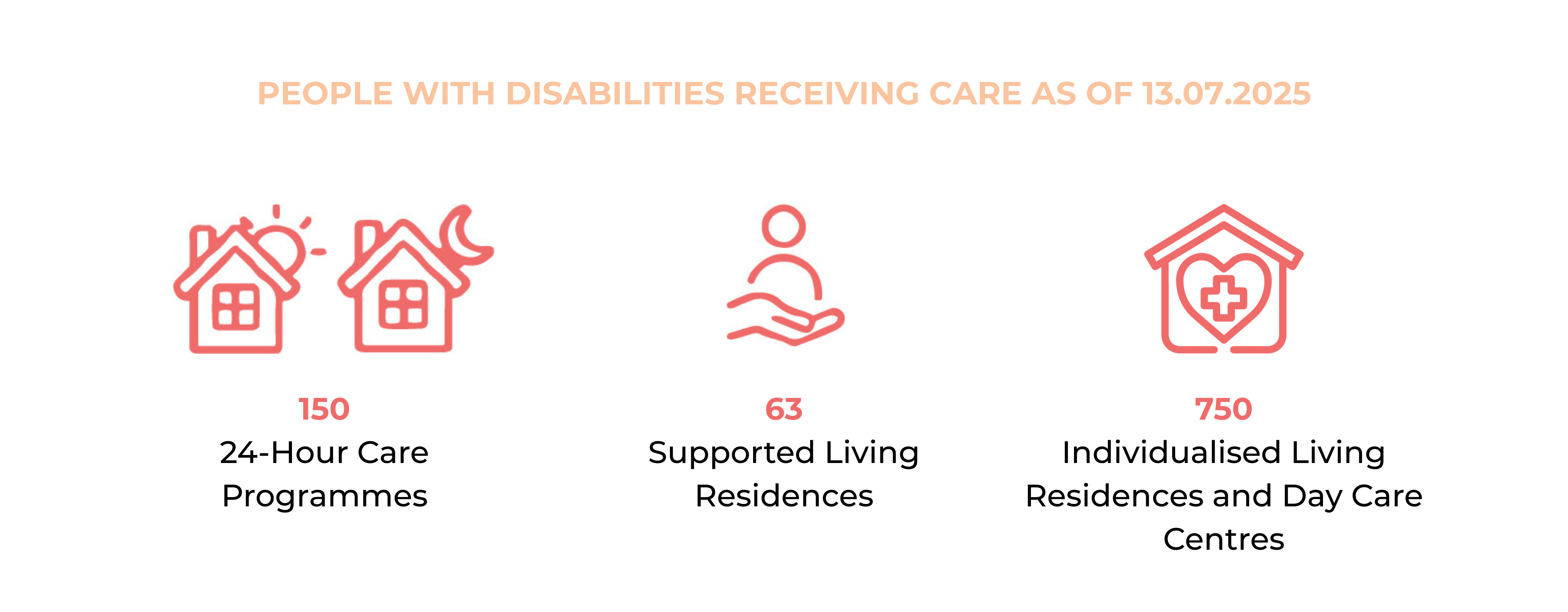
As of 13 July 2025, there were:
- 30 24-hour care programmes for people with disabilities, serving around 150 individuals, eight of which were state-operated.
- 13 supported living residences for 63 people with disabilities, with five more in development under the Recovery and Resilience Plan.
- Eight individualised living programmes and 38 day care centres, serving around 750 people with disabilities (Source: KNEWS).
Home care services, personal assistants, and telecare services
No data available.
Strategies
In 2024, Cyprus announced a revised National Disability Strategy and Action Plan 2024-2028.
Child Protection
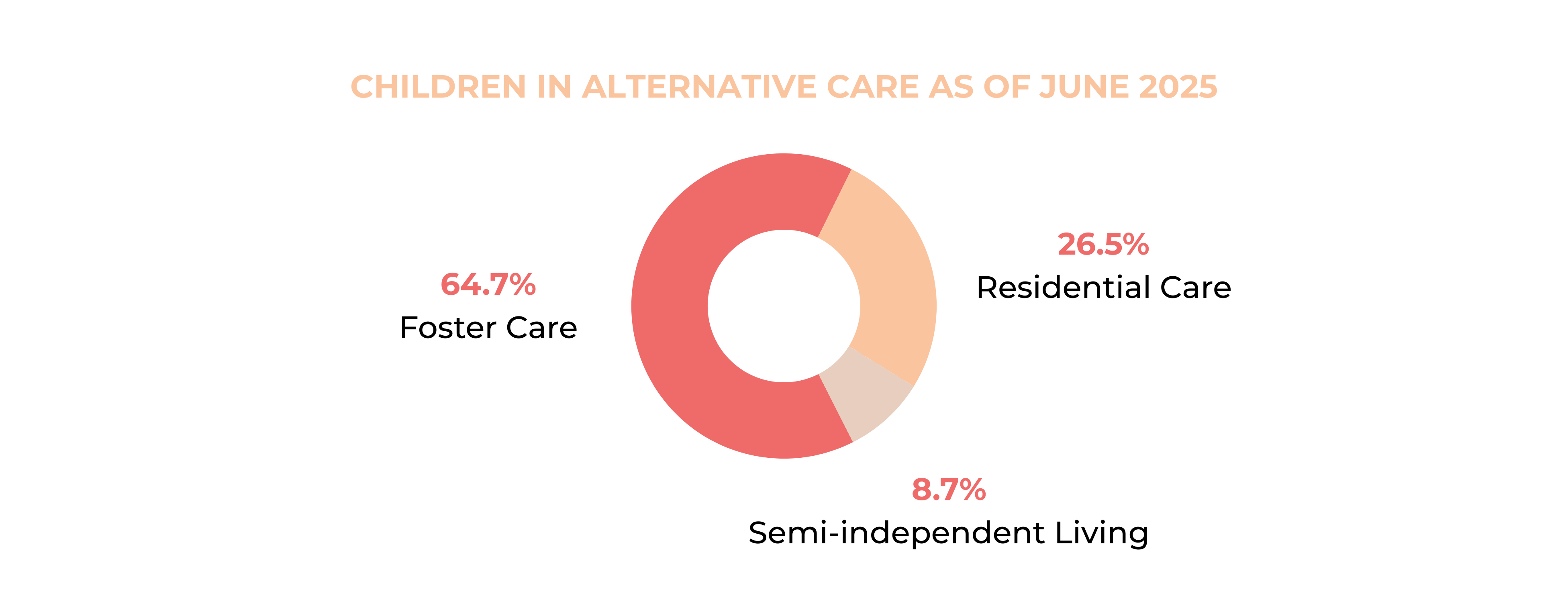
As of June 2025, 366 children were placed in alternative care. Of these:
- 237 were in foster care.
- 97 were in residential care.
- 32 were in semi-independent living (Source: Social Welfare Services – confidential).
Domestic Violence Support Services
Women experiencing domestic violence
In 2022, women represented 76% of domestic violence victims (2,614 out of 3,435) recorded by the police (Source: EIGE).
Women receiving support from domestic violence support services
Between January and October 2024, the Association for the Prevention and Handling of Violence in the Family (SPAVO) handled 3,405 incidents of family violence. In most cases, victims were women experiencing violence by their partner or former partner.
Of all 3,405 cases:
- 322 women were hosted in SPAVO’s shelters.
- 82 women joined SPAVO’s counselling services.
- 369 women received services by the Woman’s House (Source: SPAVO – confidential).
Emergency accommodation centres
As of 2024, SPAVO operated three shelters (in Nicosia, Limassol, and Paphos) for women victims of domestic violence and their children, with a capacity of, respectively, seven, five, and two rooms, totalling 47 beds and hosting victims for periods of four to six months (Source: The Advocates for Human Rights.
In 2021, SPAVO accommodated 661 women and children in its shelters (Source: SPAVO).
Strategies
In 2023, Cyprus adopted its first-ever National Strategy on Preventing and Combating Violence against Women 2023-2028.
Minimum Income Schemes
The Minimum Guaranteed Income (Ελάχιστο Εγγυημένο Εισόδημα) aims to ensure a minimum socially acceptable standard of living for individuals and families whose income and other financial resources are not sufficient to cover their basic needs. This financial benefit varies depending on the applicant’s income, household composition, and needs.
As of 31 December 2023, 2,370 minors with disabilities received the Minimum Guaranteed Income as beneficiaries, regardless of family income and assets. An additional 2,901 children received this benefit as dependents of adult beneficiaries. The total number of beneficiaries is, however, unknown (Source: Republic of Cyprus).
Housing and Homelessness Support
Housing support allowances
No data available.
Homeless people
In 2017, there were 129 homeless people, representing 0.02% of the total population. This figure included only people in emergency accommodation (e.g., shelters), but not people in accommodation for the homeless (e.g. hostels and women’s refuges), people living rough, people living in institutions, people living in unconventional dwellings, nor people staying with family/friends (Source: OECD).