Recommendation
Czechia should further develop its outreach, outpatient, and respite care services, including needs identification and care planning, as its current capacity is not sufficient. These services are a basic prerequisite for supporting people to remain in their own homes as they grow older.
Social Services Legislation
Right to access social services
✅ People’s right to access social services is recognised in the Social Services Act, last amended in 2025.
Definition of social services
✅ The Social Services Act defines social services as an activity or a set of activities that provide assistance and support to people to ensure their social inclusion or prevent their social exclusion.
National social services catalogue
✅ The Ministry of Labour and Social Affairs has an online catalogue that lists 33 types of social services, organised in three categories: social counselling, social care services, and social prevention services.
Social service providers in Czechia must be registered with the National Register of Social Services.
National social services strategic plan
✅ The National Strategy for the Development of Social Services 2016-2025 covers all the social services included in the online catalogue. However, it is not accompanied by a budget for its implementation.
Responsibilities of national, regional, and local authorities
The Social Services Act lays out the competence in the field of social services as follows.
Ministry of Labour and Social Affairs:
- Manage performance of state administration duties such as social work services.
- Elaborate a national social services strategy and monitor and evaluate its implementation, and determine social services availability in cooperation with the regions.
Regions:
- Identify the needs for the provision of social services to individuals or groups in their territory.
- Ensure the availability of information on how to access social services in their territory.
- Cooperate with municipalities, other regions, and social services providers in arranging support for people in need.
- Prepare a medium-term plan for social services development in cooperation with municipalities in the region’s territory, with representatives of social services providers and user representatives, and inform municipalities about the results of the planning process. In preparing the plan, regions shall take into account the information provided by the municipalities.
- Monitor and evaluate the implementation of social services development plans with the participation of municipalities, social services providers, and user representatives.
- Inform the Ministry of Labour and Social Affairs on the implementation of the social services development plans.
- Ensure social services availability in their territory based on the medium-term plan for social services development.
- Determine the network of social services in the region’s territory, taking into account information provided by municipalities.
Municipalities:
- Identify the needs for the provision of social services to individuals or groups in their territory.
- Ensure the availability of information on how to access social services in their territory.
- Cooperate with other municipalities, regions, and social services providers in arranging support to people in need.
- Draw up a medium-term plan for social services development in cooperation with regions, social services providers, and user representatives.
- Cooperate with counties in preparing and implementing their medium-term plans for social services. For this purpose, municipalities shall inform the counties about the needs for providing social services to individuals or groups in their territory, how to access social services, and the available resources.
- Cooperate with regions in determining their network of social services, communicating information on social services requirements to meet the needs of persons in their territory, and co-creating the conditions for meeting these needs.
Social Services Expenditure
As of 1 January 2024, Czechia's population was 10,900,555 people (Source: Eurostat). That same year, the country’s gross domestic product (at market prices) reached €318,895.7 million (Source: Eurostat).
Czechia’s 2023 total social protection expenditure was CZK 1,540,092 million:
- Sickness and health care: CZK 507,685 million.
- Disability: CZK 90,392 million.
- Old age: CZK 717,308 million.
- Survivors: CZK 44,471 million.
- Family and children: CZK 111,118 million.
- Unemployment: CZK 26,941 million.
- Housing: CZK 19,652 million.
- Social exclusion not classified elsewhere: CZK 22,525 million (Source: Ministry of Labour and Social Affairs).
Social Services Coverage
Social Services Workforce
As of 31 December 2024, there were 54,594 employees in the public social care sector as a whole, including 2,732 social workers employed in social services (Source: Ministry of Labour and Social Affairs.
Long-term Care Services for Older People
Population aged 65+
As of 1 January 2024, 20.5% of the population or 2,237,322 people were aged 65 and over (Source: Eurostat).
In 2024, 55.3% of the population aged 65+ had some or a severe level of activity limitation (Source: Eurostat).
According to the Social Services Act, people aged 1+ who require long-term care due to a long-term health condition can access the care allowance (příspěvek na péči), a non-contributory benefit that can be used for both professional and informal care. The amount granted depends on the level of dependence (grades I-IV).
In 2024, 4,475,951 care allowances were paid (Source: Ministry of Labour and Social Affairs).
In 2023, in almost 80% of cases, the legal deadline of 60 days for processing a care allowance application was not met, and in 55% of cases, the deadline was exceeded by 4 to 6 months (Source: EY).
Residential care facilities
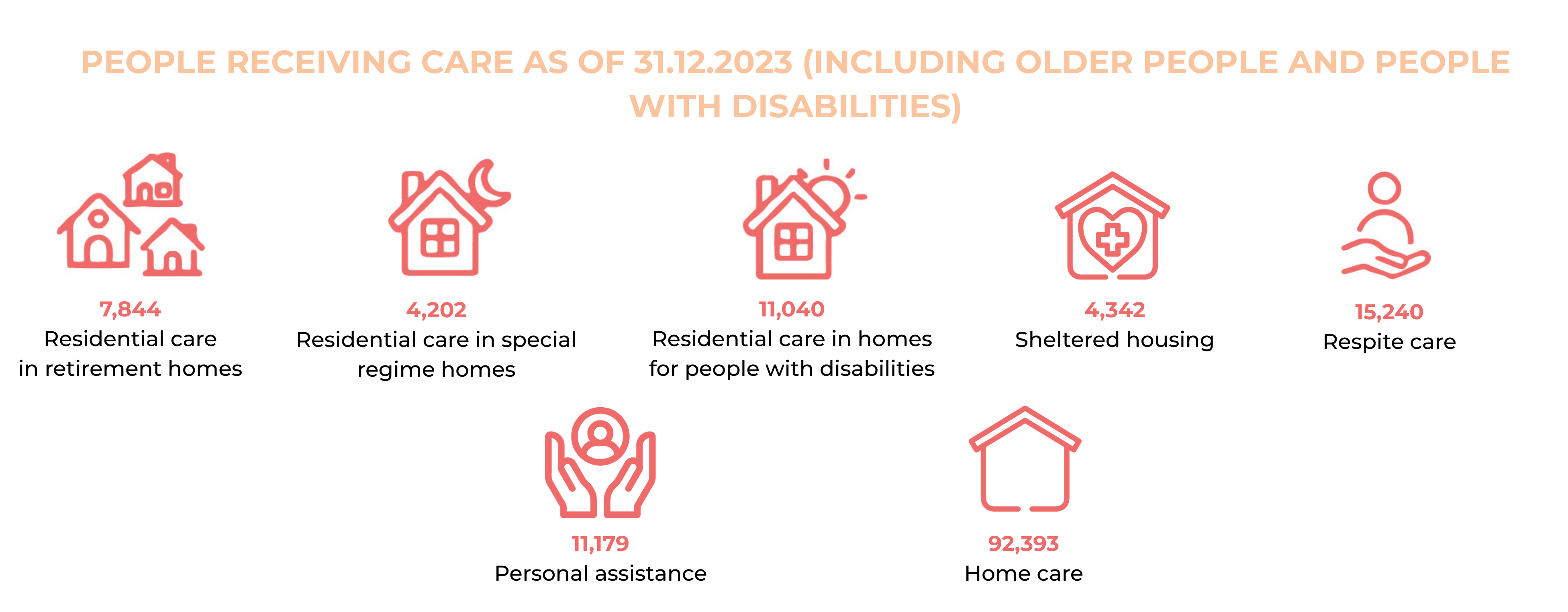
As of 31 December 2023, there were 35,667 places in retirement homes for older people and 25,439 places in homes with a special regime (intended especially for people with dementia).
At that same time, 34,165 people lived in retirement homes and 23,632 people lived in homes with a special regime. Additionally, 15,240 people received respite care services, though their age and condition are not specified (Source: CSO).
Day care centres
No data available.
Home care services
As of 31 December 2023, 92,393 people received home care services, though their ages and conditions are not specified (Source: CSO).
Personal assistants
As of 31 December 2023, 11,172 people received personal assistance, though their ages and conditions are not specified (Source: CSO).
Telecare services
No data available.
Reforms
In 2024, the Government approved an amendment to the Act on the Social-Health Boundary with the aim of coordinating health and social care to address the problems associated with separate care systems, better meet the health and social needs of people, and respond flexibly and effectively to the changing needs of people with chronic conditions. These changes should enable the provision of comprehensive care in hospitals, long-term care facilities, older people’s homes, day centres, and mental health centres. Nursing care would be provided by both in-house staff and external providers. The proposal also foresees strict requirements for equipment and staff, and failure to meet these criteria would be sanctioned (Source: Ministry of Health).
Long-term Care Services for Adults with Disabilities
Population aged 18+ with disabilities
In 2024, 566,600 people aged 15-64 had a disability (Source: CSO).
In 2024, 17.3% of the population aged 16-64 had some or a severe level of activity limitation (Source: Eurostat).
Residential care facilities
As of 31 December 2023, there were 11,496 places in homes for people with disabilities and 4,603 places in sheltered housing (chráněné bydlení).
At that same time, 11,040 people lived in homes for people with disabilities and 4,342 people accessed sheltered housing, though their ages are not specified. Additionally, 15,240 people received respite care services, though their ages and conditions are not specified (Source: CSO).
Day care centres
No data available.
Home care services
As of 31 December 2023, 92,393 people received home care services, though their ages and conditions are not specified (Source: CSO).
Personal assistants
As of 31 December 2023, 11,172 people received personal assistance, though their ages and conditions are not specified (Source: CSO).
Telecare services
No data available.
Plans
The National Plan for the Promotion of Equal Opportunities for Persons with Disabilities 2021-2025 aims to ensure equal rights and equal opportunities for people with disabilities through the availability of a dignified and independent life for this group and to create an environment that is minimally restrictive.
Child Protection
In 2024, 85,478 new cases were recorded with the child protection system. As of 31 December 2024, the total number of recorded family cases was 134,988.
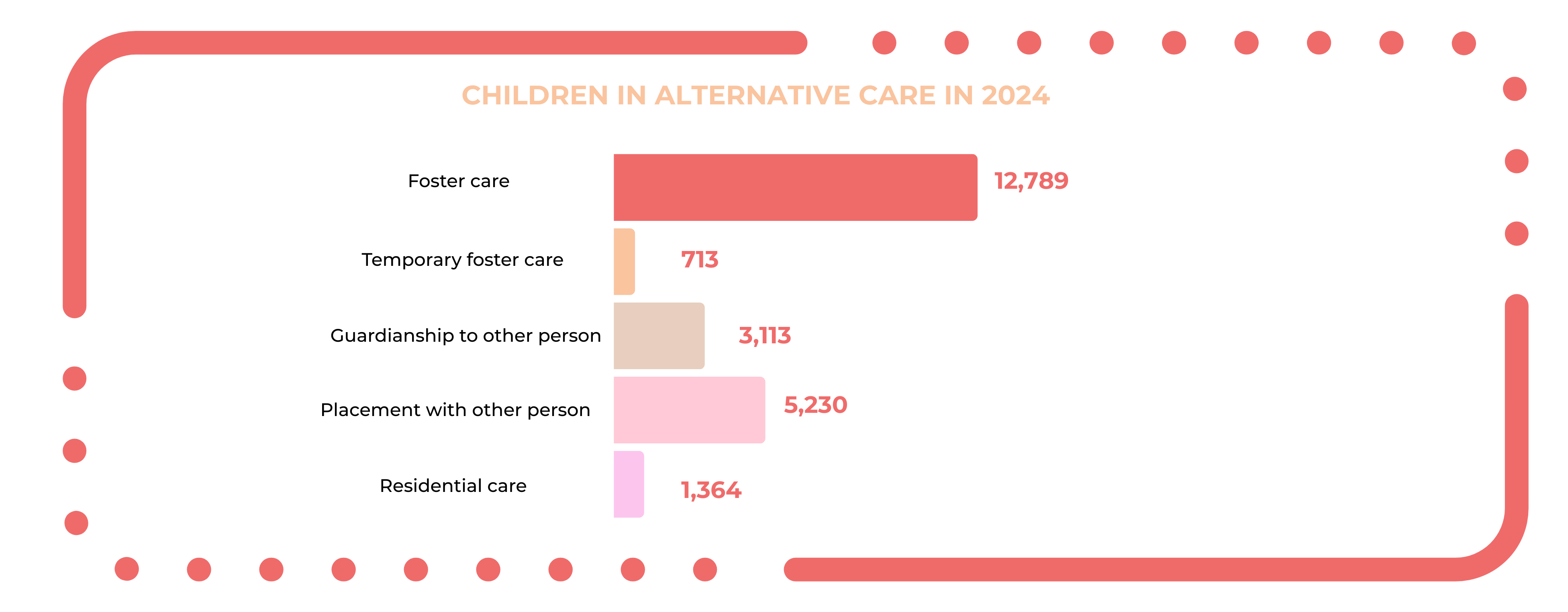
As of 31 December 2024, 21,845 children were placed in alternative care:
- Foster care: 12,789.
- Temporary foster care: 713.
- Guardianship to other person: 3,113.
- Placement with other person: 5,230.
Furthermore, in 2024, 1,364 children were in residential care (Source: Ministry of Labour and Social Affairs).
Domestic Violence Support Services
Women experiencing domestic violence
In 2023, women represented 90% of intimate partner violence victims (596 out of 665) and 68% of domestic violence victims (806 out of 1,182) recorded by the Czech police.
Furthermore, that same year, women represented 73% of victims of homicide committed by intimate partners (8 out of 11) and 50% of victims of domestic homicide (11 out of 22), recorded by police (Source: EIGE).
Women receiving support from domestic violence support services
No data available.
Emergency accommodation centres
No data available.
Minimum Income Schemes
Minimum income schemes
The Act on State Social Support foresees five types of social benefits:
- Child allowance.
- Housing allowance.
- Maternity benefits.
- Parental allowance.
- Funeral expenses.
The Act on the Living and Subsistence Minimum introduced two more social benefits:
- Living Minimum (životním minimu): a socially recognised minimum level of income to ensure sustenance and other basic personal needs.
- Subsistence Minimum (existenčním minimu): a minimum level of income which is considered to be necessary to ensure sustenance and other basic personal needs at a level allowing the individual to survive. This was introduced to increase the motivation of adults in material need. It cannot be used for dependent children, the recipients of an old-age pension, people with disabilities of grade III, and people over the age of 68.
Plans
The National Action Plan for the Prevention of Domestic and Gender-based Violence 2023-2026 foresees 22 measures under three strategic areas:
- Prevention of domestic and gender-based violence.
- Protection and support for victims of domestic and gender-based violence.
- Systemic measures to address domestic and gender-based violence and ensure access to justice for all victims of these forms of violence.
Housing and Homelessness Support
Housing support allowances
According to the Act on State Social Support, low-income individuals or families can apply for the housing allowance (příspěvek na bydlení), regardless of whether they own or rent their house or apartment. The amount granted is calculated based on income and housing costs (gas, electricity, water, waste disposal, etc.).
Furthermore, the Act on Assistance in Material Need introduced the housing supplement (doplatek na bydlení) for those who, even after receiving the housing allowance, continue to lack enough funds to pay rent and housing-related services.
In 2024, the following number of benefits were paid:
- 3,299,481 housing allowances (Source: CSO).
- 294,943 housing supplements (Source: Ministry of Labour and Social Affairs).
Homeless people
In 2023, approximately 70,000 people were homeless, including 18,000 living on the streets or in dormitories (Source: Pro prarodiče).
As of 31 December 2023, there were 7,160 places in reception centres (azylové domy) and 5,463 people accessed these centres (Source: CSO).
Reforms
From 1 October 2025, according to the Act on State Social Assistance Benefit, a new system will come into force, merging four types of social benefits (child allowance, living allowance, housing allowance, and housing supplement) into one, called the super-benefit. People who are already receiving existing benefits will be transferred to the new system gradually and will receive their first payments under the new rules from April 2026. The aim of the change is to simplify the state social assistance system, increase its efficiency, and better target assistance and evaluate the beneficiaries’ work activity (Source: Kurzy.cz).