

Recommendation
France should engage with its county councils (Départements) on a new social model focused on deinstitutionalisation and a community-based approach to care.
Social Services Legislation
Right to access social services
✅ People’s right to access social services is recognised in Law 2015-991 of 7 August 2015. Article 98 mandates the state and county councils to jointly draw a county council plan to improve the population’s access to services, including social services. This stands as a guiding principle for both national and local authorities, although it’s not enforceable as a legal right.
Definition of social services
✅ Article L312-1 of the Code of Social Action and Families provides a comprehensive list of which services fall under the category of ‘social and health care services’. These include, but are not limited to, services implementing preventive and child welfare measures, educational services for children and young adults with disabilities, support and long-term care services for older people and people with disabilities, emergency accommodation centres, and support services for vulnerable people.
Furthermore, Law 2002-2 of 2 January 2002 expanded the mission of the country’s social and health care sector, improved coordination among the various players, improved planning, and strengthened users’ rights.
National social services catalogue
❌ France does not have a national social services catalogue. However, Law 2002-2 of 2 January 2002 defines the types of benefits and services offered within the country’s social and health care sector.
National social services strategic plan
❌ France does not have a national social services strategic plan. However, according to Law 2002-2 of 2 January 2002, each county council must develop their own plan.
Responsibilities of national, regional, and local authorities
The following social services are decentralised to county councils: support for older people and people with disabilities, social inclusion and active inclusion, child protection, and family support.
Social Services Expenditure
As of 1 January 2024, France's population was 68,467,362 people (Source: Eurostat). That same year, the country’s gross domestic product (at market prices) reached €2,921,411.8 million (Source: Eurostat).
In 2023, county councils invested €43,640 million in social and health care services, distributed as follows:
- Child protection, excluding staff: €9,760 million (22%).
- Support for people with disabilities, excluding staff: €9,290 million (21%).
- Support for older people with support needs, excluding staff: €7,880 million (18%).
- Minimum income support, excluding staff: €10,850 million (25%).
- Staff and other social and health care expenses: €5,860 million (14%) (Source: Odas).
Social Services Coverage
Social Services Workforce
As of 31 December 2023, 123,101 staff were employed in the county councils’ social and health care services. These included:
- 39,351 administrative and technical staff.
- 33,710 social workers.
- 9,851 paramedical staff.
- 3,658 health care staff.
- 2,030 psychologists.
- 203 health care technical staff.
- 34,298 foster carers (Source: DREES).
Long-term Care Services for Older People
Population aged 65+
As of 1 January 2024, 21.4% of the population or 14,674,294 people were aged 65 and over (Source: Eurostat). In addition, 4,251,469 people were 60 to 64 years old (Source: Eurostat).
In 2024, 45% of the population aged 65+ had some or a severe level of activity limitation (Source: Eurostat).
In France, people over the age of 60 with support needs can apply for the personalised autonomy allowance (allocation personnalisée d’autonomie – APA), which is intended to cover in part or in full the expenses they incur to live independently at home or in a care facility. Once a complete application is submitted, the older person receives acknowledgement of this within 10 days and a response within two months (Source: Service-Public.fr).
As of December 2023, 1.36 million people received the APA, of whom:
- 815,780 continued to live at home.
- 548,961 lived in a care facility (Source: CNSA)
Residential care facilities, day care centres, home care services, and personal assistants
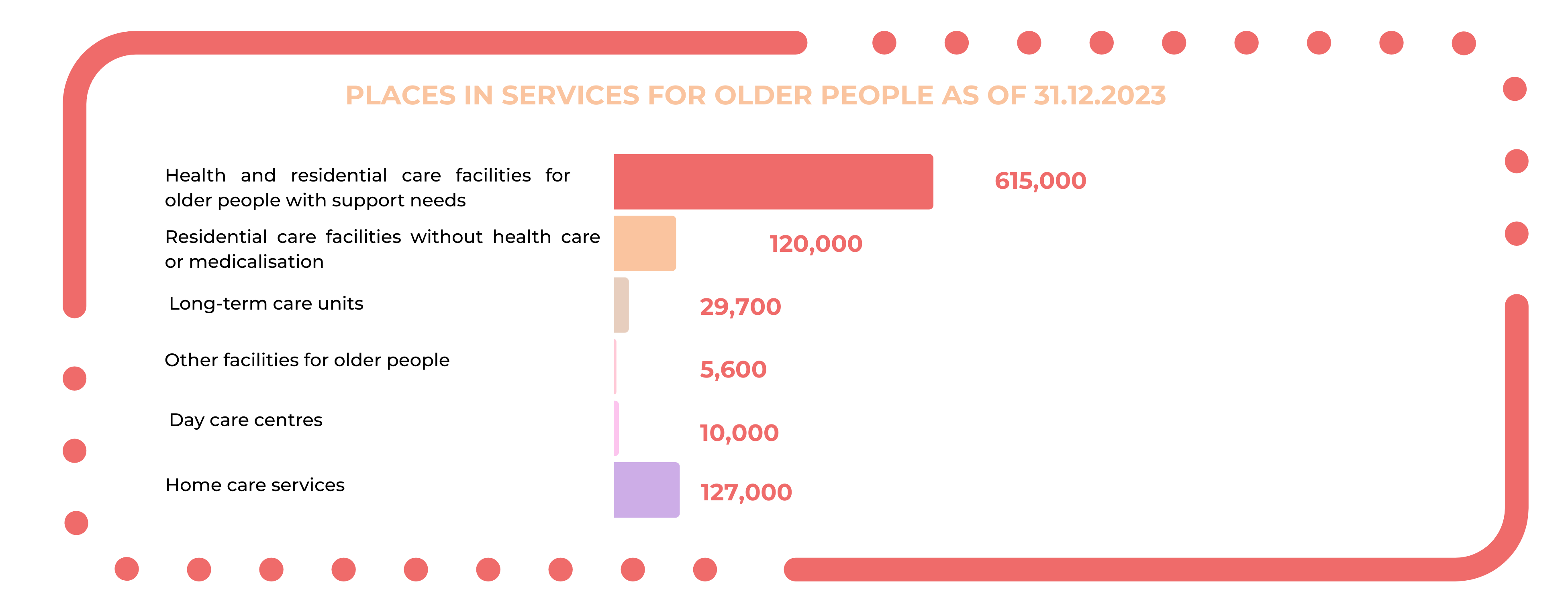
As of 31 December 2023, there were around 900,000 places available in facilities/services for older people, distributed as follows:
- Health and residential care facilities for older people with support needs (établissements d’hébergement pour personnes âgées dépendantes – EHPAD): 68%.
- Residential care facilities without health care or medicalisation (résidences autonomie – RA): 13%.
- Long-term care units (unités de soins longue durée – USLD): 3%.
- Other facilities for older people (autres établissement pour personnes âgées – EHPA, EEPA): 1%.
- Day care centres (centres d'accueil de jour – CAJ): 1%.
- Home care services (soins infirmiers à domicile – SSIAD, SPASAD): 14% (Source: CNSA).
As of 31 December 2022, the following numbers of older people were beneficiaries of county council allowances:
- APA: 1,336,300.
- Social assistance for accommodation in a residential care home (aide sociale à l’hébergement – ASH): 116,100.
- Housekeeping aid for people aged 60+: 23,900.
- Social assistance for people with disabilities aged 60+: 42,300.
- Disability compensation benefit for people aged 60+ (prestation de compensation du handicap – PCH): 124,900 (Source: DREES).
In 2017, the care plans of older people receiving the APA included, on average, 29 hours of personal assistance per month, reaching 68 hours/month for those with the highest degree of support needs (Source: DREES).
Telecare services
In 2024, about 12% of people aged 75+ were equipped with a remote assistance device (Source: Cahiers de la Silver Economie).
Reforms
Law 2024-317 of 8 April 2024 established several measures to prevent loss of autonomy, fight social isolation, and promote the rights of older people and people with disabilities in health care facilities or nursing homes. In particular, this law:
- Stipulated the residents’ right to receive daily visitors without needing to inform the facility in advance.
- Stipulated the residents’ right to welcome their pets, under certain conditions.
- Created a local public service of autonomy (service public départemental de l'autonomie – SPDA) for older people and people with disabilities, as well as their caregivers, to simplify processes and ensure they are supported to continue living at home.
Long-term Care Services for Adults with Disabilities
Population aged 18+ with disabilities
In 2022, the following percentage of the population aged 15 and over reported having difficulties in daily life:
- At least one significant functional limitation, such as vision or hearing issues and motor difficulties: 27.7%.
- At least one significant restriction in carrying out essential activities such as dressing themselves and shopping: 10.3%.
- A severe restriction in carrying out daily activities, for at least six months: 8.7% (Source: DREES).
In 2024, 19.6% of the population aged 16-64 had some or a severe level of activity limitation (Source: Eurostat).
Residential care facilities, day care centres, home care services, and personal assistants
As of 31 December 2022, 141,200 people lived in care facilities for people with disabilities, including:
- 137,700 adults with disabilities.
- 1,900 young people over the age of 16 residing in full-time care facilities for children with disabilities.
- 1,600 children under the age of 16 residing in full-time care facilities for children with disabilities (Source: DREES).
In 2024, there were 542,000 places in facilities and health care services for people with disabilities (établissements et services médico-sociaux – ESMS), of which:
- 361,000 for adults.
- 181,000 for children (Source: CNSA).
Places for adults with disabilities were distributed as follows:
- 33% in sheltered workshops.
- 27% in residential care facilities.
- 18% in medical or paramedical care.
- 18% in nursing care and home assistance with daily living.
- 3% in social and professional reintegration.
- 1% in other facilities/services (Source: CNSA).
At the end of 2023, the following number of people with disabilities were beneficiaries of county council allowances:
- Allowance for adults with disabilities (allocation aux adultes handicapés – AAH): 1,353,000.
- Disability pension following a work-related accident or illness: 1,058,000.
- Disability pension: 871,000.
- Support allowance for children with disabilities (allocation d’éducation de l’enfant handicapé – AEEH): 474,000.
- Disability compensation benefit (prestation de compensation du handicap – PCH): 407,000.
- Housing and social assistance at home or in a residential care home: 168,000 (Source: CNSA).
Telecare services
No data available.
Reforms
Law 2024-1028 of 15 November 2024 was introduced to improve the identification and support of people with neurodevelopmental disabilities and promote respite for their caregivers.
Child Protection
As of 31 December 2023, 384,900 children and young people under the age of 21 (jeunes majeurs) were involved with the country’s child protection service (aide sociale à l’enfance – ASE), reaching a total of 396,900 measures. Of these children/young people:
- 175,800 (46%) received home support:
- 51,800 under the supervision of the child protection service (aide éducative à domicile – AED).
- 124,000 under the supervision of the child protection service and a children’s judge (aide éducative en milieu ouvert – AEMO).
- 221,000 (57%) received assistance from the child protection service, of whom:
- 17,100 were placed directly by a judge, most often in the care of a trustworthy third party.
- 203,900 were specifically entrusted to the child protection service:
- 45,800 following a decision taken by the county council.
- 158,100 following a judicial decision (Source: DREES).
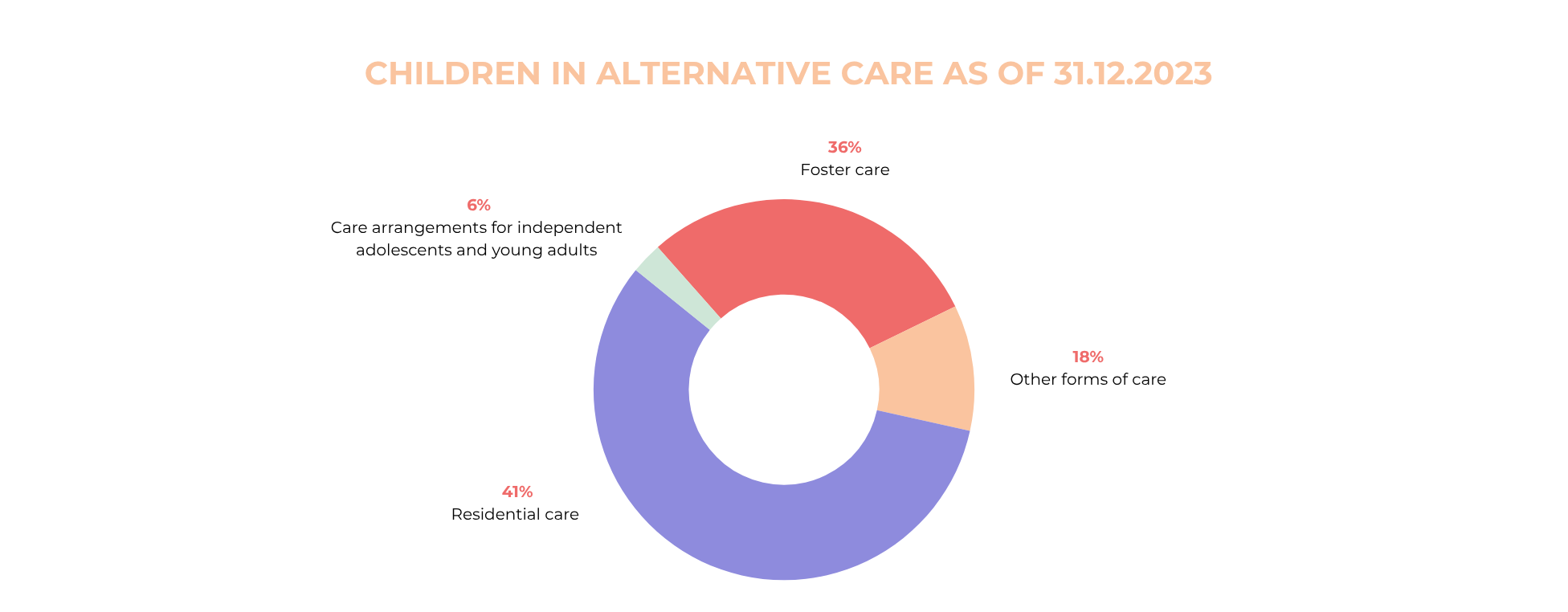
Excluding those placed directly by a judge, of the children/young people supported by the child protection service:
- 82,600 were placed in residential care.
- 72,700 were placed in foster care.
- 6% were under care arrangements for independent adolescents and young adults.
- 18% were placed in other forms of care, such as boarding schools, placements with future adoptive families, and placements with a trustworthy third party (Source: DREES).
In 2024, county councils’ average times were as follows:
- 34 days to offer a placement in residential care.
- 21 days to offer a placement in foster care.
- 103-114 days to offer administrative measures (Source: National Assembly).
Reforms
In April 2024, the National Assembly set up a committee of enquiry into the shortcomings of child protection policies (Commission d’enquête sur les manquements des politiques publiques de protection de l’enfance), whose work came to a conclusion in April 2025. In its final report, the committee’s spokesperson reported that the French model is characterised by an excessive reliance on residential care, making France the leading European country in terms of placing children in care (Source: National Assembly).
Domestic Violence Support Services
Women experiencing domestic violence
In 2023, 271,263 individuals aged 15+ were registered by French security forces as victims of domestic violence perpetrated by a partner or ex-partner. Of these, 85% were women and represented:
- 84% of the victims of physical violence.
- 86% of the victims of verbal or psychological violence.
- 97% of the victims of sexual violence (Source: Ministry of Interior).
Women receiving support from domestic violence support services
In 2023, the following number of measures were put in place to protect victims of domestic violence:
- 3,997 protection orders.
- 4,531 emergency mobiles (téléphone grave danger – TGD): 3,231 emergency calls were made through these phones, requesting security force intervention.
- 963 anti-approach bracelets (bracelet anti-rapprochement – BAR): 10,421 requests for security force intervention were made after an alarm was triggered by these bracelets (Source: Ministry of Justice).
Victims of domestic violence can request immediate, one-off financial aid to seek shelter and cover their immediate needs. Introduced in December 2023, 33,441 aids were issued in the first year alone (Source: CAF).
Emergency accommodation centres
As of 31 December 2023, there were 10,666 places in facilities dedicated to women victims of domestic violence and their children, of which:
- 10,147 in accommodation facilities.
- 519 in adapted housing (Source: National Observatory on Violence Against Women).
Reforms
Decree 2023-1077 of 23 November 2023 established a unit specialised in domestic violence in each court of law and court of appeal. The unit is composed of judges, prosecutors, directors of court registry services, clerks, legal assistants, and contract agents and aims to ensure better coordination of efforts to combat domestic violence.
Law 2024-536 of 13 June 2024 introduced the possibility for the family court judge to issue an immediate provisional protection order to promptly protect victims of domestic violence and, if applicable, their children in the event of serious and imminent danger. Furthermore, the law extended the duration of the measures issued under the protection order from six months to 12 months and made amendments to ensure this protection is warranted even if the couple does not cohabit.
Minimum Income Schemes
The active solidarity income (revenu de solidarité active – RSA) guarantees a minimum income and supports people’s return to work. The amount received is calculated based on each person’s resources and their household composition (Source: France Travail).
At the end of December 2024, 1.85 million people received the RSA (Source: DREES).
Reforms
Law 2023-1196 of 18 December 2023 introduced the automatic registration of every person receiving the RSA, as well as their partners, with France Travail. This registration entails the signature of an engagement contract outlining an action plan to reach each person’s objectives of social and active inclusion, and each RSA beneficiary must dedicate at least 15 hours weekly to specific activities to achieve these objectives. Non-compliance with these conditions can result in the suspension or withdrawal, in whole or in part, of their allowance.
Housing and Homelessness Support
Housing support allowances
There are three types of housing benefits, financed by the National Housing Assistance Funds (fonds national d’aide au logement – FNAL), means-tested, and non-cumulative:
- Family housing allowance (allocation de logement familiale – ALF), awarded to families with a dependent child or a dependent relative with a disability and young couples without dependent children who are not eligible for the APL.
- Social housing allowance (allocation de logement sociale – ALS), awarded to those who are not eligible for the ALF or the APL, such as young people, students, households without children, older people, and people with disabilities.
- Personalised housing assistance (aide personnalisée au logement – APL), intended for those living in subsidised housing.
As of 31 December 2022, 5,978,900 households received housing assistance, benefitting 11.6 million people:
- ALF: 905,900.
- ALS: 2,342,100.
- APL: 2,730,900 (Source: DREES).
Homeless people
Based on data from 2013, it was estimated that, in 2023, there were 4.1 million people in poor housing conditions. Of these:
- 1,098,000 did not have their own housing:
- 330,000 were homeless (living on the streets, in shelters, etc.).
- 25,000 lived in hotels.
- 100,000 lived in makeshift accommodation.
- 643,000 stayed with others out of necessity.
- 2,819,000 lived in very difficult housing conditions (Source: Foundation for Housing the Disadvantaged).
As of 31 January 2021, there were 3,094 accommodation centres responsible for receiving, housing, and supporting adults and families in difficult situations. These centres had available 218,200 places, of which:
- 210,500 were permanent.
- 7,700 were temporary.
At that time, the aggregated occupancy rate was 90% and 197,300 individuals were recorded as receiving accommodation, including:
- 190,600 in permanent places.
- 6,600 in temporary places (Source: DREES).
In 2024, 29,642 social housing units were allocated to people in need, including homeless people and those living in makeshift accommodation (Source: info.gouv.fr).
Plans
The second Housing First Plan 2023-2027 reinforced France’s commitment to transform its public policy on homelessness, placing a particular focus on preventive measures, notably the prevention of rental evictions.