
Recommendation
Greece should adopt a new law on social care that includes:
- Recognition of a minimum set of fundamental social services.
- A network of public social services with nationwide coverage.
- Basic governance mechanisms covering at least data collection, a national quality framework, and coordination between social care providers and the national health system.
- Distribution of responsibilities and funding between national and local authorities.
Social Services Legislation
Right to access social services
✅ According to Article 1 (2) of Law 2646 of 20 October 1998, which established Greece’s National Social Care System (NSCS), any person who legally resides in Greece and is in need is entitled to social care, to be provided by the NSCS. However, this law does not guarantee individual rights to specific social services. Instead, it allows the Ministry responsible for social care services, which is the Ministry of Social Cohesion and Family Affairs, to define the scope of application (content, beneficiaries, and access conditions) of these services through national social care programmes targeting specific groups (e.g., families, older people, people with disabilities, and people in crisis).
Definition of social services
✅ Article 1 (1) of Law 2646 of 20 October 1998 broadly defines ‘social care’ as the protection provided to individuals or groups through prevention and rehabilitation programmes aimed at creating conditions for equal participation in economic and social life and ensuring a decent standard of living.
This Article also stipulates that the primary purpose of social care is to support the family. Article 2 (2) defines four key areas of social care: family, children, and youth; older people; people with disabilities; and vulnerable population groups and groups in a state of emergency.
Furthermore, Article 3 (2) defines three levels of social care in Greece:
- Primary social care is designed to provide open care services aimed at preventing social needs and the early detection of socio-economic exclusion risks. These services are mainly provided at local level.
- Secondary social care is intended to provide residential care services aimed at treating and rehabilitating people with disabilities and preventing and combating the consequences of socio-economic exclusion. These services are mainly provided at regional or subregional level.
- Tertiary social care refers to specialist care mainly provided at national or regional level.
National social services catalogue
❌ The Ministry of Social Cohesion and Family Affairs provides some general information about social services and benefits on its website, under ‘Social Solidarity’. However, this information is broad and may not be easily accessible.
The National Centre for Social Solidarity has launched an e-platform for the general public to access information on social services, but this remains incomplete.
National social services strategic plan
❌ In July 2024, the Ministry of Social Cohesion and Family Affairs adopted the National Strategy on Long-term Care, a hybrid strategic plan that focuses mainly on long-term care services for older people and people with disabilities, but also refers to certain forms of social care outside the scope of long-term care, such as foster care for children, after-school care for children, and social clubs for older people. The strategy is not accompanied by a budget for its implementation.
Responsibilities of national, regional, and local authorities
In Greece, there is:
- Central administration, comprising the Ministries and the legal bodies of public law which operate under their supervision.
- Local government, including 13 regions and 332 municipalities.
According to Law 2646 of 20 October 1998:
- Coordination of social care services is ensured by national programmes drawn up by the state (Ministry of Social Cohesion and Family Affairs) and implemented by the National Social Care System (NSCS) entities. However, these national programmes are yet to be issued.
- Planning, design, and funding of social care services is the responsibility of the state (Ministry of Social Cohesion and Family Affairs).
- Delivery of social care services is carried out by NSCS, which includes:
- Public providers, consisting of:
- One national provider for emergency social care (National Centre for Social Solidarity).
- 12 regional providers for other forms of care (Social Welfare Centres).
- Private non-profit providers which are certified as NSCS entities by the Ministry of Social Cohesion and Family Affairs and, under this status, may deliver both community and residential care and support services.
- Public providers, consisting of:
- Regulation of standards is the responsibility of the Ministry of Social Cohesion and Family Affairs, for both public and private providers.
- Monitoring of social needs and programmes and inspection of social care providers are carried out by the regions through special agencies called ‘Regional Social Inclusion Observatories’ and specialised officers called ‘Social Consultants’. Municipalities also hold inspection responsibilities for certain care providers, such as crèches and pre-school childcare.
Social Services Expenditure
As of 1 January 2024, Greece’s population was 10,400,720 people (Source: Eurostat). That same year, the country’s gross domestic product (at market prices) reached €237,573.4 million (Source: Eurostat).
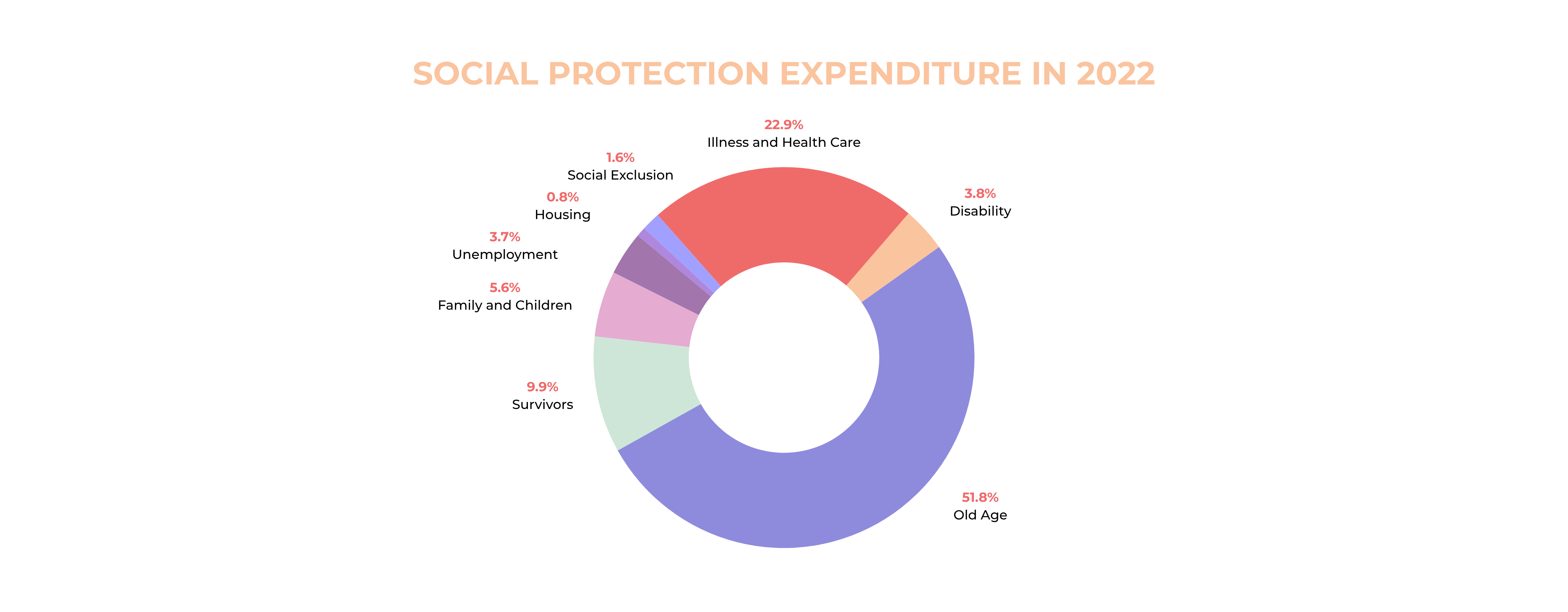
Greece’s 2022 total social protection expenditure was €49,614 million (cash benefits and benefits in kind), as follows:
- Illness and health care: €11,342 million (benefits in kind only: €10,772 million)
- Disability: €1,901 million (benefits in kind only: €70 million).
- Old age: €25,711 million (benefits in kind only: €2 million).
- Survivors: €4,907 million (benefits in kind only: €96 million).
- Family and children: €2,758 million (benefits in kind only: €177 million)
- Unemployment: €1,818 million (benefits in kind only: €70 million).
- Housing: €405 million (benefits in kind only: nil).
Social exclusion: €772 million (benefits in kind only: €102 million) (Source: ELSTAT).
Social Services Coverage
Social Services Workforce
As of May 2025, 7,390 social workers were registered with the Hellenic Association of Social Workers (SKLE) and worked in public and private social services. Of those working specially in public social services (3,920 social workers):
- 1,858 were on a permanent contract.
- 2,062 were on a fixed-term contract (Source: SKLE – confidential).
Long-term Care Services for Older People
Population aged 65+
As of 1 January 2024, 23.3% of the population or 2,426,089 people were aged 65 and over (Source: Eurostat).
In 2024, 50% of the population aged 65+ had some or a severe level of activity limitation (Source: Eurostat).
Due to limited availability, access to public residential and home care services is reserved for claimants with very low personal or family income. Therefore, most older people are excluded from public long-term care support.
The average waiting time for access to home care services (if available) varies from a few days (in small municipalities) to several months (in large municipalities). The average waiting time for access to public residential or day care centres (if available) exceeds one year (Source: SKLE – confidential).
Residential care facilities
Publicly funded residential care for older people and people with disabilities is mostly delivered by the Social Welfare Centres, with beneficiaries paying fees based on personal income. There are 12 Social Welfare Centres in the country, covering all regions except the Peloponnese. Furthermore, the Social Welfare Centre in the Western Macedonia region does not have a long-term care department. Municipalities’ participation in residential care is marginal (only 8 out of 332).
In 2021, there were 2.5 long-term care beds per 1,000 people aged 65+ (Source: Ministry of Social Cohesion and Family Affairs).
In 2023, 1,057 older people received residential care through the main public social care providers (Social Welfare Centres) (Source: ELSTAT).
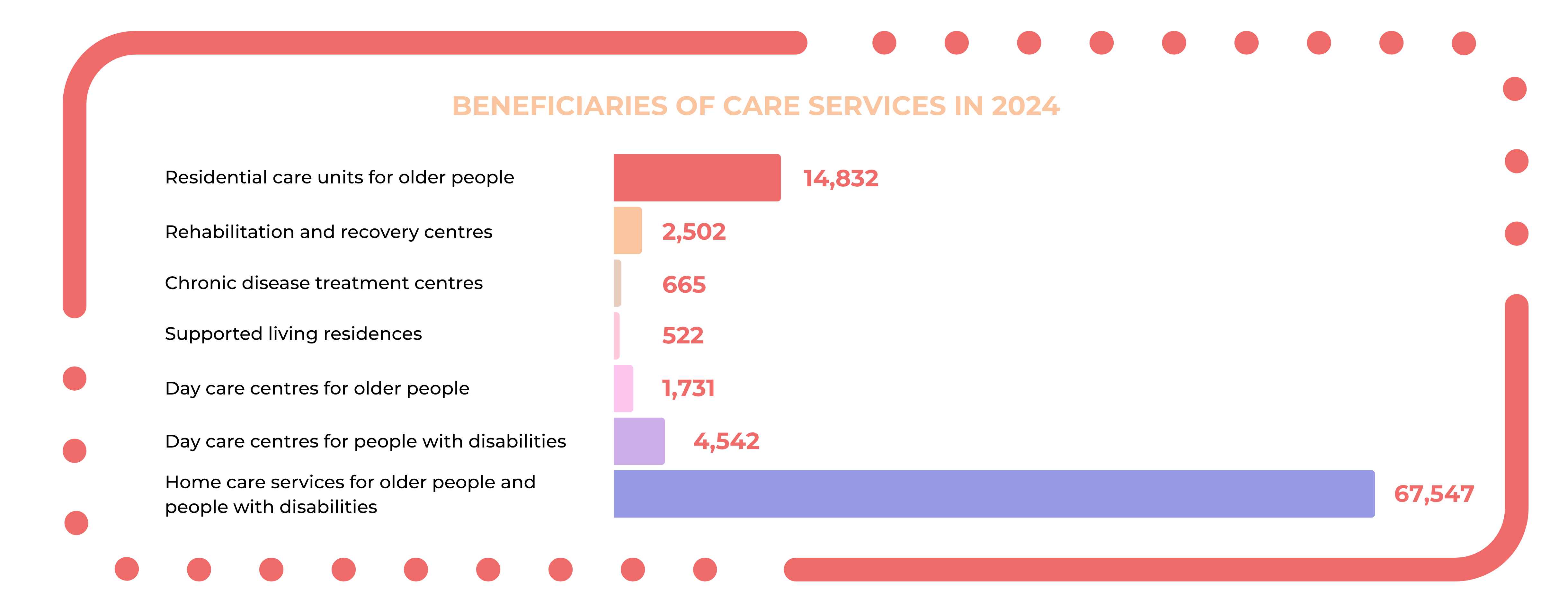
In 2024, there were 290 residential care units for older people (Μονάδες Φροντίδας Ηλικιωμένων – ΜΦΗ) (both public and private), benefiting 14,832 people (Source: Ministry of Social Cohesion and Family Affairs).
Day care centres
In 2024, there were 78 day care centres for older people (Κέντρα Ημερήσιας Φροντίδας Ηλικιωμένων – ΚΗΦΗ), benefiting 1,731 people (Source: Ministry of Social Cohesion and Family Affairs).
Home care services
In 2024, 281 of 332 municipalities provided home help services for older people and/or people with disabilities (Βοήθεια στο Σπίτι - ΒΣΣ), with workers’ salaries covered by the Ministry of Interior. Hours of care vary from municipality to municipality, depending on availability and capacity.
In 2024, 67,547 people benefited from these services (Source: Ministry of Social Cohesion and Family Affairs).
Personal assistants
Publicly funded personal assistance services are only available for people with disabilities aged 16-64.
Telecare services
Telecare services are not systematically provided. They are generally scarce and provided by municipalities or regions in the context of EU-funded projects.
Long-term Care Services for Adults with Disabilities
Population aged 18+ with disabilities
In 2023, 23.1% of the population aged 16+ had a disability (Source: Eurostat).
In 2024, 6.8% of the population aged 16-64 had some or a severe level of activity limitation (Source: Eurostat).
The average waiting time for access to public residential or day care centres (if available) exceeds one year (Source: SKLE – confidential).
Residential care facilities
In 2023, 711 people aged 18-64 received residential care through the main public social care providers (Social Welfare Centres) (Source: ELSTAT).
In 2024, there were:
- 44 rehabilitation and recovery centres (Κέντρα Αποθεραπείας-Α ποκατάστασης – ΚΑΑ), benefiting 2,502 people.
- 10 chronic disease treatment centres (Θεραπευτήρια Χρονίων Παθήσεων – ΘΧΠ), benefiting 665 people.
- 113 supported living residences (Στέγες Υποστηριζόμενη ς Διαβίωσης – ΣΥΔ), benefiting 522 people (Source: Ministry of Social Cohesion and Family Affairs).
Day care centres
In 2024, there were 86 day care centres for people with disabilities (Κέντρα Διημέρευσης και Ημερήσιας Φροντίδας για Άτομα με Αναπηρία – ΚΔΗΦ ΑμεΑ), benefiting 4,542 people (Source: Ministry of Social Cohesion and Family Affairs).
Home care services
In 2024, 281 of 332 municipalities provided home help services for older people and/or people with disabilities (Βοήθεια στο Σπίτι - ΒΣΣ), with workers’ salaries covered by the Ministry of Interior. Hours of care vary from municipality to municipality, depending on availability and capacity.
In 2024, 67,547 people benefited from these services (Source: Ministry of Social Cohesion and Family Affairs).
Personal assistants
In April 2025, 1,837 people benefited from the Personal Assistant for People with Disabilities Programme, a pilot project funded by the EU Recovery and Resilience Fund that has been in operation since 2021. The programme pays the salary of a personal assistant chosen by the beneficiary through a public registry of certified private professionals (Source: OPEKA).
Telecare services
Telecare services are not systematically provided. They are generally scarce and provided by municipalities or regions in the context of EU-funded projects.
Strategies
The National Strategy for the Rights of Persons with Disabilities 2024-2030, based on the principles of social justice and social cohesion, reinforced the government’s commitment to the inclusion of people with disabilities and introduced bold reforms aimed at removing barriers and strengthening the protection of their rights at all levels of government.
Child Protection
Child protection services are mainly delivered in the context of the National Social Care System (NSCS), under the supervision of the Ministry of Social Cohesion and Family Affairs:
- 28 child protection facilities operate as departments of the Social Welfare Centres.
- Private non-profit NSCS providers operate 43 child protection facilities.
Municipalities’ participation in child protection services is marginal (only 2 out of 332).
Between 2020 and 2024, there have been 680 foster care placements.
In December 2024, 1,185 children were placed in residential care, of whom:
- 1,100 (93%) were accommodated in 71 public and private non-profit facilities supervised by the Ministry of Social Cohesion and Family Affairs and two public care facilities supervised by the Ministry of Citizen Protection.
- 85 (7%) were third-country nationals with the status of unaccompanied children accommodated in 14 private non-profit facilities supervised by the Ministry of Migration and Asylum (Source: Ministry of Social Cohesion and Family – confidential).
Children at risk can remain in hospitals, awaiting an alternative care placement, for a period varying from a few days to several months (Source: SKLE – confidential). In April 2025, 54 children were in public hospitals, awaiting transfer (Source: Ministry of Social Cohesion and Family Affairs – confidential).
Domestic Violence Support Services
Women experiencing domestic violence
In 2023, 9,886 women experienced domestic violence. The perpetrator was the husband in 41.4% of cases (Source: Hellenic Police).
Women receiving support from domestic violence support services
There are 44 counselling centres and 20 shelters nationwide, operated mainly by municipalities under the coordination of the General Secretariat for Equality and Human Rights of the Ministry of Social Cohesion and Family Affairs (Source: Ministry of Social Cohesion and Family Affairs).
Between January and September 2024, 3,490 female victims of violence received counselling, psychosocial support, and legal aid from the network of counselling centres mentioned above (Source: Ministry of Social Cohesion and Family Affairs).
Emergency accommodation centres
Between January and September 2024, 248 women were accommodated in emergency shelters. 83% (206) of them came in because of domestic violence (Source: Ministry of Social Cohesion and Family Affairs).
Minimum Income Schemes
In Greece, people can access a variety of welfare benefits, including:
- Minimum Guaranteed Income: a means-tested programme supporting households with income below the (legally defined) poverty threshold. The programme provides a monthly cash benefit, free access to public health care, social, and employment services.
- Social Solidarity Allowance for Uninsured Older People: a means-tested monthly allowance for people older than 67 years of age who are not entitled to a social security old age pension (20 years of legal residence in Greece is required).
In April 2025, 160,395 people received the Minimum Guaranteed Income and 21,204 people received the Social Solidarity Allowance for Uninsured Older People (Source: OPEKA).
Housing and Homelessness Support
Housing support allowances
Low-income households residing in rented dwellings can access, under specific conditions, the Housing Allowance, a means-tested monthly cash benefit. The amount depends on the number of household members.
In April 2025, 194,789 people received the Housing Allowance (Source: OPEKA).
Homeless people
In 2023, there were 1,387 homeless people, representing 0.01% of the total population. This figure included only people in emergency accommodation (e.g., shelters) and accommodation for the homeless (e.g. hostels and women’s refuges), but not people living rough, people living in institutions, people living in unconventional dwellings, or people staying with family/friends (Source: OECD).
In 2025, 117 out of 145 municipalities (81%) reported having no emergency accommodation of any kind (Source: Hellenic Observatory for Poverty and Homelessness – confidential).
In 2024, there were 1,070 beds across homeless shelters nationwide, of which:
- 401 in transitional shelters.
- 669 in dormitories (Source: Hellenic Observatory on Poverty and Homelessness – confidential).
Strategies
The National Strategy for Social Inclusion and Poverty Reduction 2021-2027 sets out:
- Main reform initiatives to enhance the country’s social fabric.
- New strategic priorities for social inclusion and the fight against social exclusion.
- New goals and general directions of the country's national development policy in the field of social inclusion.