
Recommendation
Malta should make a concerted effort to attract more people to join the social services workforce at all levels; otherwise, this sector will not be sustainable in the long term. This includes attracting more social workers, youth workers, community workers, care workers, as well as foster carers.
Social Services Legislation
Right to access social services
✅ Malta does not have a social services act. Instead, individuals’ right to access to social rights is recognised through various Laws of Malta, including:
- Chapter 210: Persons with Disability (Employment) Act.
- Chapter 318: Social Security Act.
- Chapter 413: Equal Opportunities (Persons with Disability) Act.
- Chapter 528: Health Act.
- Chapter 581: Gender-Based Violence and Domestic Violence Act.
- Chapter 582: Social Care Standards Authority Act.
- Chapter 602: Minor Protection (Alternative Care) Act.
- Chapter 627: United Nations Convention on the Rights of Persons with Disabilities Act.
- Chapter 633: Convention on the International Protection of Adults (Ratification) Act.
- Chapter 640: Older Persons Standards Authority Act.
- Subsidiary Legislation 595.18: Aġenzija Sapport (Establishment as an Agency) Order.
Definition of social services
❌ There is no legal definition of social services, but social services are generally understood as social welfare services and social benefits:
- Social welfare services refer to a broad range of services provided to individuals with needs arising from disabilities, age-related issues, and other social factors. They are not limited to one particular age or population group and are provided in many forms, ranging from child protection to residential and end-of-life care.
- Social benefits are explained in Chapter 318: Social Security Act.
National social services catalogue
✅ The population in Malta can access information about all the available government services on the Servizz.gov website.
National social services strategic plan
✅ Malta has two social services strategic plans covering social welfare services. However, both plans mention the need for further consolidation of services:
Responsibilities of national, regional, and local authorities
Social services are provided by national agencies as well as NGOs. National agencies are funded by the government, while NGOs provide services under Chapter 492: Voluntary Organisations Act and are financed through Public Social Partnerships with the national government and fundraising.
National agencies include:
- Foundation for Social Welfare Services (FSWS): provides social welfare services, in particular in relation to alcohol and substance abuse and in relation to other social welfare problems prevalent in the country, especially those related to family welfare.
- Aġenzija Sapport: provides services, support, and guidance to people with disabilities, their support networks, and their communities.
- Active Ageing and Community Care (AACC): provides residential care and community care to support older people to continue living in the community.
- Housing Authority: provides and sustains decent social and affordable housing opportunities, promoting stability and supporting social mobility.
The Social Care Standards Authority (SCSA) is responsible for regulating and inspecting social services across Malta. This includes defining standards, licensing service providers, and ensuring compliance through inspections. SCSA also provides guidance to service providers on improving service quality.
The Older Persons Standard Authority (OPSA) regulates geriatric services to ensure the wellbeing and rights of older people, promoting quality care, inclusivity, and a supportive environment. It involves service users and providers in the development and improvement of standards.
Social Services Expenditure
As of 1 January 2024, Malta’s population was 563,443 people (Source: Eurostat). That same year, the country’s gross domestic product (at market prices) reached €23,071.0 million (Source: Eurostat).
Preliminary data on Malta’s 2024 general government expenditure indicates a total of €8,292 million, of which:
- Public order and safety: €334 million.
- Housing and community amenities: €54 million.
- Health: €1,059 million.
- Education: €1,038 million.
- Social protection: €2,501 million (Source: NSO).
Social Services Coverage
Social Services Workforce
As of May 2025, 460 social workers were registered in Malta (Source: People and Standards Division, Office of the Prime Minister; FSWS; Aġenzija Sapport – confidential).
Long-term Care Services for Older People
Population aged 65+
As of 1 January 2024, 18.4% of the population was aged 65 and over (Source: Eurostat), or 103,406 individuals (Source: Eurostat).
In 2024, 93% of the population aged 65+ had some or a severe level of activity limitation (Source: Eurostat).
In 2024, 4,584 older people were assessed as having long-term care needs and 1,657 older people were assessed and transferred into long-term care. Access to long-term care services ranges from one day after assessment to a few months. In the case of residential care, admission depends on the results of the needs assessment. Urgent admissions may take a few days, depending on the availability of beds (Source: AACC – confidential).
Residential care facilities
In 2024, there were 4,532 places in residential care facilities for older people, all occupied (Source: (AACC – confidential).
Day care centres
In 2024, there were 28 Active Ageing Centres (previously referred to as Day Centres) and an additional seven in collaboration with local councils and other groups. 2,493 older people attended the Active Ageing Centres (Source: AACC – confidential).
Home care services
In 2024, 1,249 older people benefited from the Carer at Home Scheme, the vast majority of whom employed a full-time carer. Only 54 older people purchased a number of hours per week (lower than 40 hours) from care-providing companies or carers employed on a part-time basis (Source: AACC – confidential).
Telecare services
In 2024, 4,052 older people benefited from Telecare, a pendant through which they can trigger an alarm, and a further 38 older people made use of Telecare on the Move, a GPS-incorporated device intended for older people with dementia that allows for two-way communication between the user and their relatives or a dedicated call centre and that detects if the user falls.
Personal assistants
In 2024, 7,688 older people accessed the Home Help Service, which offers help with light domestic chores and errands (Source: AACC – confidential).
Long-term Care Services for Adults with Disabilities
Population aged 18+ with disabilities
In 2024, 10.7% of the population aged 16-64 had some or a severe level of activity limitation (Source: Eurostat).
As of 29 April 2025, 2,642 people with disabilities aged 18-59 received services through Aġenzija Sapport (Source: MIV – confidential).
Residential care facilities
In 2024, there were 11 community homes operated by Aġenzija Sapport and fully occupied by 49 adults with disabilities (mostly with autism and intellectual disabilities). A further 198 adults with disabilities were registered across 18 community homes operated by NGOs and 3 group homes privately operated.
Furthermore, in 2024, around 1,345 people with disabilities (including children) accessed respite care.
From the moment a long-term care assessment is completed, it takes approximately 2 months to access respite care. Residential care, on the other hand, does not have a clear timeline: a placement only becomes available when someone else leaves. Moreover, Aġenzija Sapport is moving towards deinstitutionalisation and looking into innovative community set-ups, rather than traditional homes.
In 2024, in line with its deinstitutionalisation strategy, Aġenzija Sapport started the Transitional Service, involving two adults with disabilities. Transitional placements are time-framed residential arrangements tailored to the individual's needs, during which there is a focus on developing life skills and informed decision-making (Source: MIV – confidential).
Day care centres
In 2024, there were 11 day care centres operated by Aġenzija Sapport and fully occupied by 396 adults with disabilities. A further 97 adults with disabilities were registered across day care centres operated by NGOs or co-managed with Aġenzija Sapport, of whom:
- 15 in a day care programme provided by an NGO.
- 44 in the Spero Day Centre.
- 38 in the Star Day Centre (Source: MIV – confidential).
Home care services
Aġenzija Sapport does not offer home care (Source: MIV – confidential).
Personal Assistants
The Independent Community Living Schemes, managed by Aġenzija Sapport, offer financial assistance to people with disabilities to employ personal assistants in their homes. In 2024, 454 people with disabilities used these schemes (Source: MIV – confidential).
Telecare services
Aġenzija Sapport does not offer telecare (Source: MIV – confidential).
Reforms
In 2025, the Protection of Adults in Situations of Vulnerability Act (PASVA) was launched for public consultation. This consultation reflects national efforts to further strengthen the protection, autonomy, and support for adults with disabilities. These legislative advancements reinforce Malta’s commitment to align with the UNCRPD and promote inclusive community-based services.
Malta is developing a Personal Assistance Reform as part of its National Strategy on the Rights of People with Disabilities 2021-2030. This reform is for adults but also targets minors and youth with disabilities. In preparation for this reform, Aġenzija Sapport engaged in consultations with various stakeholders. The reform aims to establish a personal budget system, aligning Malta’s disability services with Article 19 of the UNCRPD, its General Comment no. 5, and the Guidelines on deinstitutionalisation. Professionals, including personal assistants, social workers, and other specialists, will be involved in this project.
Child Protection
In 2024, the Child Protection Services of the Foundation for Social Welfare Services worked with 4,204 cases, involving 4,036 individuals. Of these, at the end of the year:
- 408 were in the intake phase.
- 896 were on the waiting list.
- 481 were not accepted/no longer required.
- 1250 were active.
- 0 were on hold, dormant.
- 162 were on hold, pending.
- 1007 were closed (Source: FSWS).
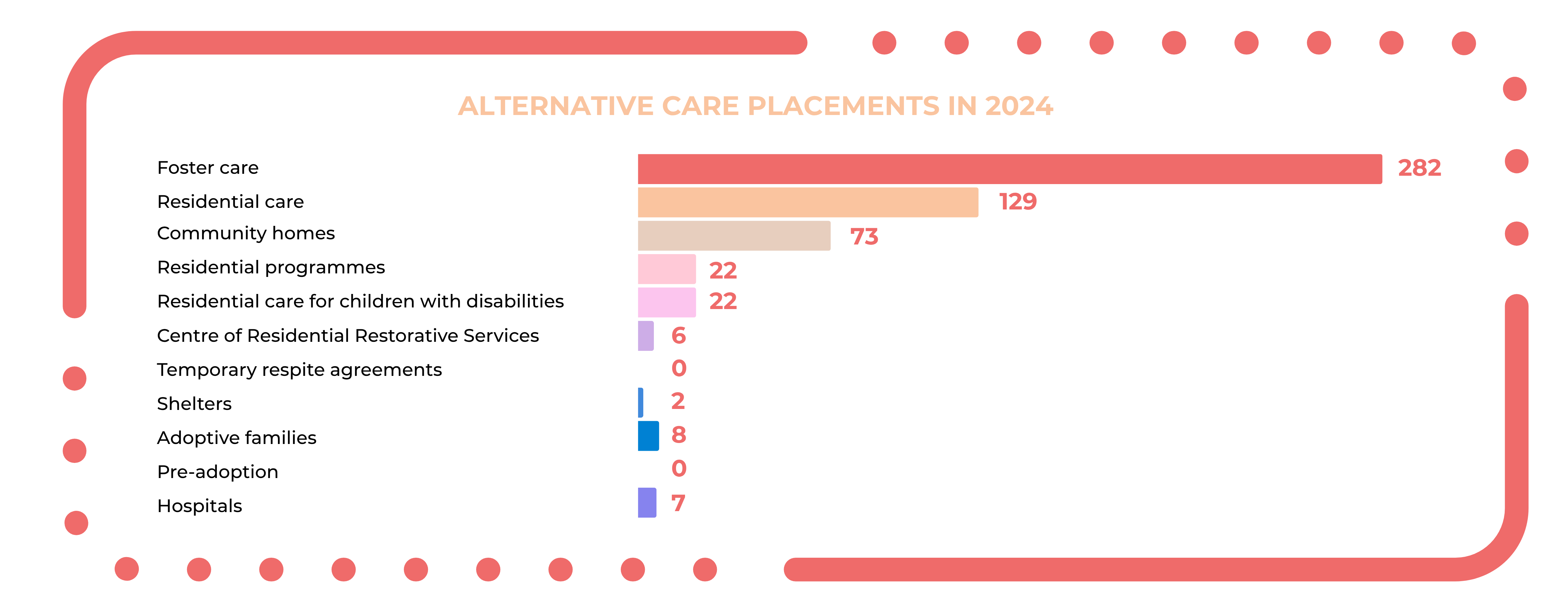
In 2024, 551 alternative care placements were recorded, involving 520 children and young people (children may have more than one placement during the same year). Of these, 92 were older than 18 years of age. The types of placements were:
- Foster care: 282.
- Residential care: 129.
- Community homes: 73.
- Residential programmes: 22.
- Residential care for children with disabilities: 22.
- Centre of Residential Restorative Services: 6.
- Temporary respite agreements: 0.
- Shelters: 2.
- Adoptive families: 8.
- Pre-adoption: 0.
- Hospitals: 7 (Source: FSWS).
Domestic Violence Support Services
Women experiencing domestic violence
In 2023, 3,589 individuals reported experiencing domestic violence or making use of services available within this area, 2,705 of whom were females (75.4%) (Source: NSO).
Women receiving support from domestic violence support services
In 2024, the Domestic Violence Service worked with 2,882 cases, involving 2,666 individuals. Of these cases, 2,326 involved female service users (81%) (Source: FSWS).
In 2024, the Għabex Shelter worked with 191 cases, involving 187 individuals. Of these cases, 150 involved female service users (79%) (Source: FSWS).
In 2024, the Gozo Domestic Violence Service worked with 109 cases, involving 97 individuals. Of these cases, 89 involved female service users (82%) (Source: FSWS).
Emergency accommodation centres
In 2024, there were four emergency accommodation centres for victims of domestic violence, offering a total of 41 beds. That same year, these centres received 394 referrals and processed 182 admissions (Source: FSWS – confidential).
Reforms
In February 2024, a Police Gender-based and Domestic Violence Unit was inaugurated at Santa Lucija. The unit, which operates 24/7, provides victims of domestic violence with a supportive environment staffed not only by police officers but also by social workers, all committed to providing assistance and care (Source: Malta Police Force).
In July 2024, the Domestic Violence Risk Assessment Service, within the Domestic Violence Service, started adopting the Danger Assessment and the Ontario Assault Risk Assessment tools to assess the level of risk of those who file a police report regarding violence and abuse and identify the appropriate support services and protection for the victim. This change was the result of a public inquiry in 2022 (Source: FSWS).
Minimum Income Schemes
Individuals and families experiencing financial difficulties can access a variety of minimum income schemes, aimed at guaranteeing a basic standard of living and primarily managed through national social security provisions. These programmes include:
- Family benefits.
- Non-contributory benefits.
- Work, incentives, and unemployment benefits: In particular, the In-Work Benefit and the Tapering of Benefits help individuals and households move away from dependency on benefits by gradually reducing support as income from work increases, and by supplementing the earnings of low-wage workers to make employment financially rewarding. This approach encourages self-sufficiency and reduces reliance on welfare assistance.
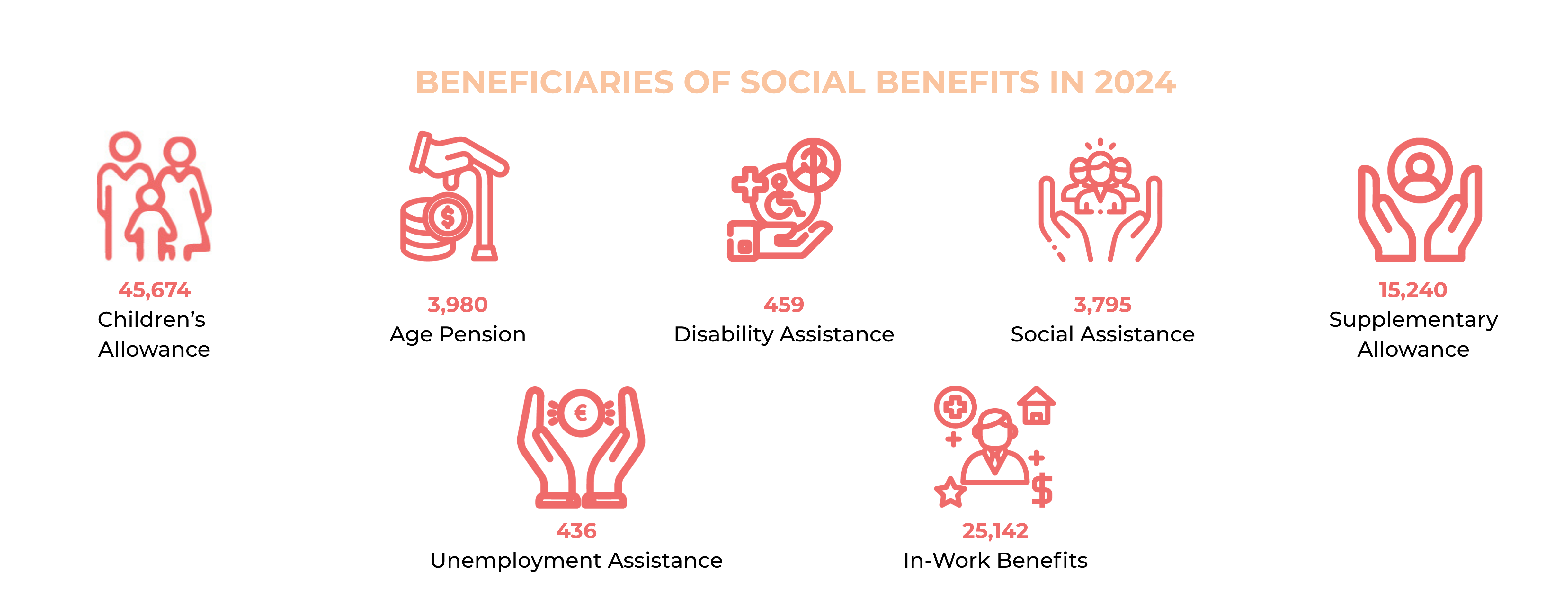
In 2024, beneficiaries of social security non-contributory benefits included:
- Children’s Allowance: 45,674.
- Age Pension: 3,980.
- Disability Assistance: 459.
- Social Assistance: 3,795.
- Supplementary Allowance: 21,125.
- Unemployment Assistance: 436.
- In-Work Benefit: 25,142 (Source: NSO).
Reforms
The 2025 Budget introduced enhanced medical assistance, increased support for people with disabilities and carers, expanded eligibility for free medicines, and a rise in the capital asset limits used to determine eligibility for various benefits.
Housing and Homelessness Support
Housing support allowances
The Housing Authority provides various housing support allowances targeting different profiles, separate from the minimum income schemes. These schemes can be grouped into three categories:
- Schemes that provide financial assistance to improve rental affordability:
- The Housing Benefit Scheme: a monthly means-tested benefit that supports tenants renting from the private sector by contributing to their rent payments, thus ensuring more affordable rents.
- The Pre-1995 Rent Subsidy Scheme: financial assistance provided to tenants living in private residential properties leased before 1 June 1995 to ensure their rents remain affordable, offering peace of mind and preventing evictions from the homes where they have spent most of, if not their entire lives.
- Schemes intended to assist buyers or tenants in becoming homeowners.
- Schemes designed to increase buyers’ purchasing power and enhance housing quality by covering property refurbishment expenses.
In 2024, 4,070 households benefited from the Housing Benefit Scheme, and 1,640 households benefited from the Pre-1995 Rent Subsidy Scheme (Source: Housing Authority).
Additionally, one of the Housing Authority's key services is the allocation of social housing to individuals and families in need. Those who cannot afford to purchase or lease a dwelling in the private sector can apply to be allocated a government dwelling.
At the end of 2024, 474 new social housing applications were submitted, and 1,679 applicants were on the waiting list (Source: Housing Authority).
Homeless people
In 2024, the Appogg Homeless Service worked with 570 cases, involving 535 individuals. Of these cases:
- 335 were at risk of homelessness.
- 185 were roofless.
- 23 were couch-surfers.
- 27 did not specify their status at referral (Source: FSWS).
In 2024, the Gozo Homeless Service worked with 218 cases, involving 193 individuals. Of these cases:
- 77 were at risk of homelessness.
- 108 were roofless.
- 9 were couch-surfers.
- 24 did not specify their status at referral (Source: FSWS).
The provision of emergency accommodation for homeless people is done by third-sector non-governmental organisations, which receive financing through Public-Social Partnerships. In 2024, there were ten shelters for homeless people, offering approximately 185 beds in total. That same year, 463 referrals were recorded, although this number is not exhaustive, and 646 admissions were processed (Source: FSWS – confidential).
Strategies
The National Strategy for Poverty Reduction and Social Inclusion 2025-2035 places homelessness as a very high priority that needs to go hand in hand with ensuring affordable housing. It also suggests introducing a definition of homelessness to be able to gather national statistics that will then allow an analysis to help advance towards the right type of support.