
Recommendation
Poland should consider introducing the Social Services Centres model as a mandatory solution in all municipalities. Social Services Centres were introduced in 2019 as an alternative to “old-style” social support institutions, which focused on a narrow range of support, mainly for social groups in difficult life situations. Social Services Centres are rapidly developing social services and changing the paradigm of the social care system.
Social Services Legislation
Right to access social services
❌ In Poland, regulations do not explicitly recognise accessing social services as an individual right.
Definition of social services
✅ Article 2 (1) of the Act of 19 July 2019 on the provision of social services by Social Services Centres provides a framework definition of social services, though this is often criticised for being too general: social services are activities undertaken by the municipality to meet the needs of individuals and families in the local community and improve their quality of life, in the following 14 areas: family policy, family support, foster care system, social assistance, health promotion and protection, support for people with disabilities, public education, employment, culture, culture and tourism, civic activity, housing, environmental protection, and professional and social inclusion.
Furthermore, working definitions used at local government level emphasise that social services are:
- Not intended for people in difficult life situations, but may be used by anyone who needs them.
- Preventive, supportive, or care-oriented.
- Implemented close to the local community.
- Covering various sectors: social assistance, education, health, housing, employment, etc. (Source: Korczak University).
National social services catalogue
❌ The Act of 19 July 2019 on the provision of social services by Social Services Centres does not contain a final catalogue of social services, but it does define them and provides examples. The catalogue is open-ended, and the legal definition of services emphasises the purpose of social services, which is to meet the various needs of individuals and communities.
National social services strategic plan
✅ The direction for social services development is set out in the Strategy for the Development of Social Services, Public Policy until 2030 (with a Perspective until 2035), adopted in 2022. This strategy identifies groups requiring support and defines what actions should be taken by entities at regional and local levels, including the creation of social services and catalogues of services. To support the implementation of the strategy, government financial instruments have been created by the Ministry of Family, Labour and Social Policy, based on both national and EU funds.
Responsibilities of national, regional, and local authorities
The Ministry of Family, Labour and Social Policy is responsible for developing community-based social services to meet the needs of people requiring support in their daily lives. In addition to creating a framework for the deinstitutionalisation process, the Ministry financially supports the development of various services for people with care needs, senior citizens, and people with disabilities through dedicated programmes developed by local governments.
Local authorities must provide social assistance and cannot refuse to help a person in need. Assistance can also not be denied by entities to which the local government has delegated tasks.
Non-governmental organisations play an important role in providing social services. The non-profit sector is strongly developed in Poland, although fragmented.
The creation of Social Services Centres has allowed the transformation of the social care system and the development of community-based social services. There are 2,479 municipalities in Poland. So far, 128 ‘old type’ units have completed the transformation, and 270 municipalities are in the process of transforming from ‘old’ units to new ones.
Social Services Expenditure
As of 1 January 2024, Poland’s population was 36,620,970 people (Source: Eurostat). That same year, the country’s gross domestic product (at market prices) reached €845,651.9 million (Source: Eurostat).
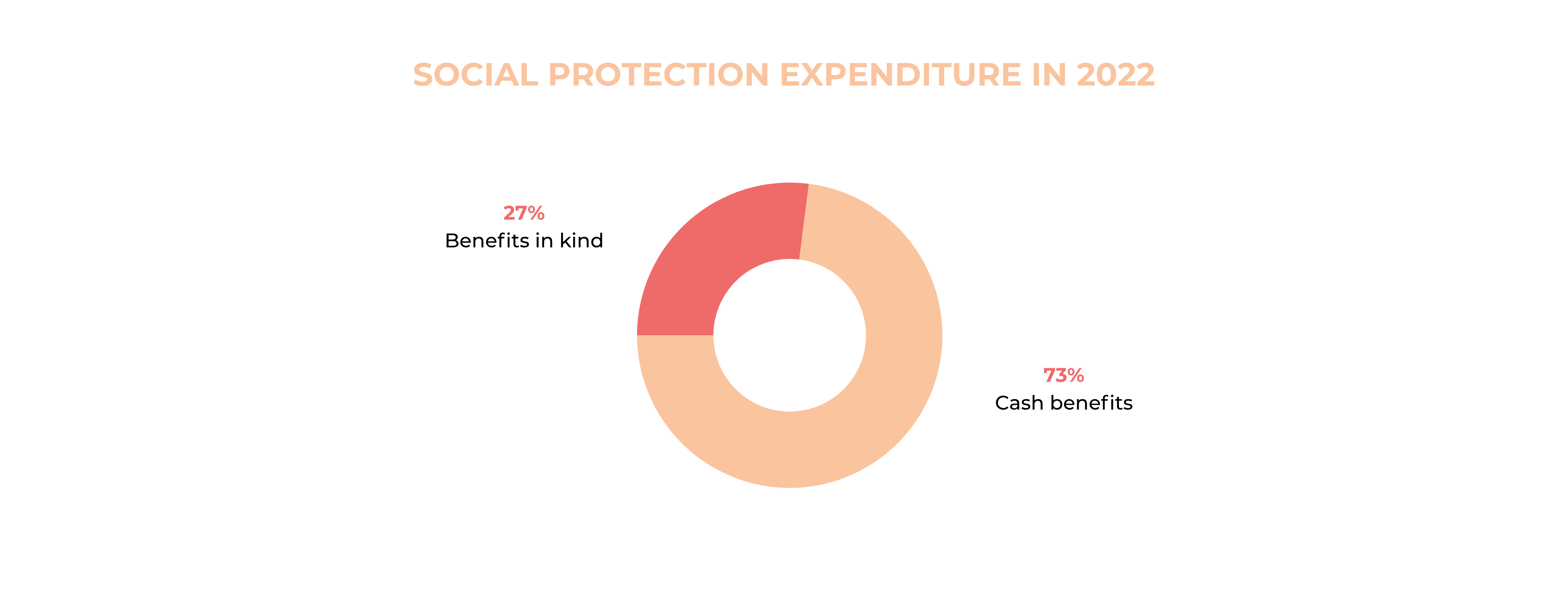
Poland's 2022 expenditure on social protection benefits was €136,178.37 million, of which:
- 36,925.57 million: benefits in kind.
- 99,252.80 million: cash benefits (Source: Eurostat).
Social Services Coverage
Social Services Workforce
In 2024, there were 22,046 social workers and a total of 132,333 people employed in public social services (Source: Ministry of Family, Labour and Social Policy).
Long-term Care Services for Older People
Population aged 65+
As of 1 January 2024, 20.5% of the population or 7,499,669 people were aged 65 and over (Source: Eurostat).
In 2024, 46% of the population aged 65+ had some or a severe level of activity limitation (Source: Eurostat).
In Poland, long-term care for older people is provided by two separate systems: the health care and the social care systems. Services and statistics are not integrated, and there is no official definition of long-term care, making it difficult to accurately identify the number of people covered by the various forms of care.
Residential care facilities
In 2024, there were 123,620 places in residential care facilities for older people:
- 38,984 in the health care system.
- 84,636 in the social care system.
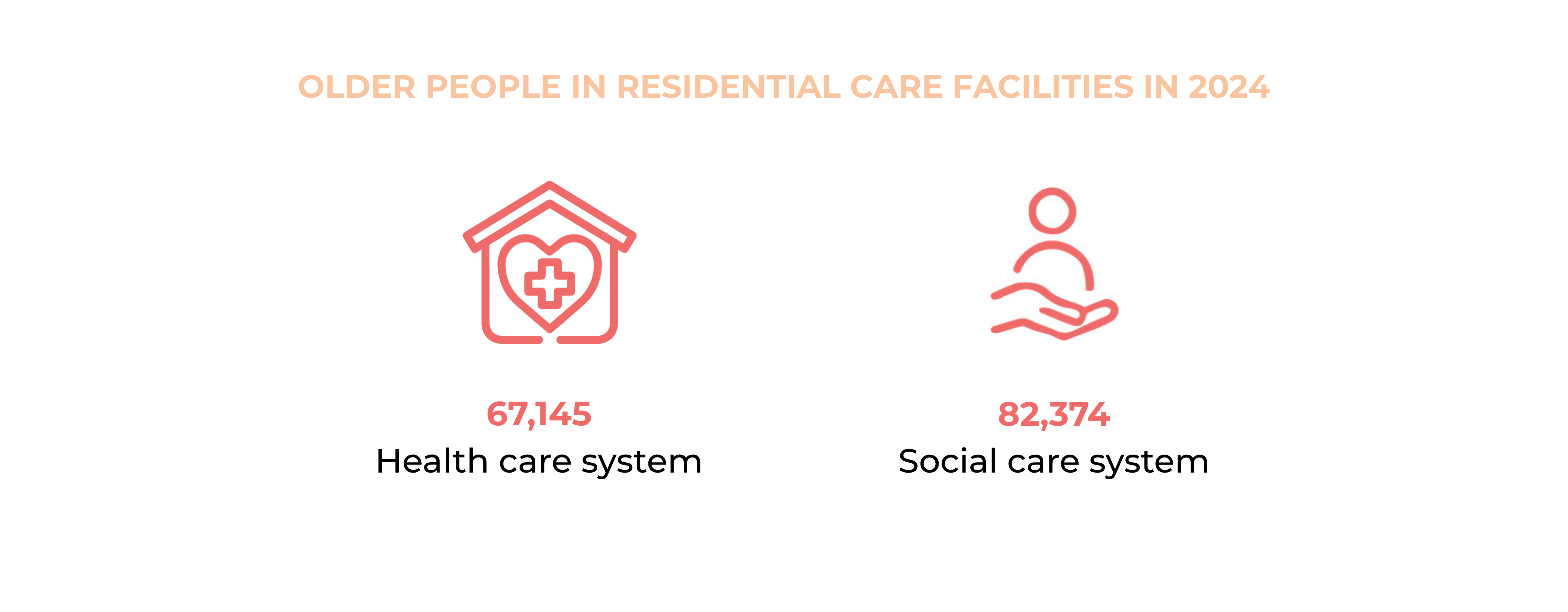
In 2024, there were 149,519 older people enrolled in publicly funded residential care facilities:
- 67,145 people in facilities run by the health care system.
- 82,374 people in facilities run by the social care system (Source: Statistics Poland; Local Data Bank).
In 2023, the average waiting time for admission to residential care facilities run by the health sector was 87 days for urgent cases and 165 days for people in stable health. In 2024, the number of people waiting for residential care facilities run by the health sector was 18,236 (Source: Ministry of Health – confidential).
The waiting time for a place in a facility run by the social sector depends on local conditions in each municipality and region (municipalities run the homes). A formal decision takes about a month but does not automatically guarantee a place, and the waiting period for admission can vary from ‘immediate’ to even more than a year (Ministry of Family, Labour and Social Policy – confidential).
Day care centres
In 2024, there were 2,931 day care centres financed from the local government budget, offering 64,079 places. These centres are mostly used by older people and people with disabilities (Source: Local Data Bank).
A further 20,706 places were financed from the central budget, though it is unclear how many were for older people (Source: Ministry of Family, Labour and Social Policy).
Since 2015, the Polish government has been implementing the Senior+ programme, which subsidises the creation and operation of day care centres for older people in municipalities. In 2022-2023, 1,080 day care centres were created under the programme, with over 25,000 users (Source: Ministry of Family, Labour and Social Policy).
Home care services
Nursing care at home is provided by the health care system. In 2023, 52,842 older people received this (Source: Ministry of Health).
Long-term home care entitles people who use it to a minimum of 1.5 hours of care and a minimum of 4 visits per week, which amounts to a total of at least 6 hours of care per week per patient. In exceptional cases, visits are also possible on weekends and public holidays, but only if medically justified (Source: Minister of Health).
The social care system provides care services and specialised care services, such as assistance with daily activities, personal hygiene, meal preparation, and assistance with interacting with the environment. In 2024, 111,537 people used home care services, and an additional 14,555 people with mental health conditions received support at home. However, their age and condition are not specified (Source: Ministry of Family, Labour and Social Policy – confidential).
Personal assistants
In 2024, care services, including assistance and help with activities such as shopping, preparing meals, personal hygiene, and nursing care recommended by a doctor, were provided to 11,537 older people (Source: Ministry of Family, Labour and Social Policy).
Telecare services
Telecare is not financed by the health care system but rather developed based on local and regional government activities and programmes financed by the Ministry of Family, Labour and Social Policy. An estimated 90,000-100,000 people are covered by public telecare services in various forms (pilot projects, local and regional programmes), though it is unclear how many are aged 65+ (Source: Korczak University – confidential).
Reforms
As part of its Recovery and Resilience Plan, Poland is working on implementing a long-term care reform, whose priorities are:
- Standardising the definition of long-term care.
- Increasing funding by up to 200%.
- Creating quality systems and key performance indicators.
- Improving the coordination of long-term care between health and social assistance.
- Developing informal care and staff training (Source: World Bank).
In 2024, the Inter-Ministerial Team for the Care of Older People was established, tasked with preparing definitions of long-term care, standards, coordination mechanisms, and quality monitoring tools in accordance with the provisions of the Recovery and Resilience Plan.
Long-term Care Services for Adults with Disabilities
Population aged 18+ with disabilities
In 2023, there were 1,643,400 people with disabilities aged 20-64 (Source: Statistics Poland).
In 2024, 13.6% of the population aged 16-64 had some or a severe level of activity limitation (Source: Eurostat).
Residential care facilities
In 2024, there were 49,208 places in residential care facilities managed by the public sector as well as 2,543 places across 1,028 assisted living apartments intended in particular for people with disabilities.
In 2024, 71,708 people with disabilities of all ages received residential care from both public and private sectors:
- 69,208 in residential care facilities.
- 2,500 in supported housing (Source: Statistics Poland).
Waiting times for residential care can range from several weeks to over a year, depending on the region and city.
Day care centres
In 2024, there were approximately 30,000adults with disabilities enrolled in publicly funded day care centres (Source: Ministry of Family, Labour and Social Policy).
Home care services
In 2024, approximately 45,000people with disabilities of all ages received nursing care at home provided by the health care system (Source: Ministry of Family, Labour and Social Policy).
The social care system provides care services and specialised care services, such as assistance with daily activities, personal hygiene, meal preparation, and assistance with interacting with the environment. In 2024, 111,537 people used home care services, and an additional 14,555 people with mental health conditions received support at home. However, their age and condition are not specified (Source: Ministry of Family, Labour and Social Policy – confidential).
Personal assistants
In 2023, 44,102 people with disabilities, including 3,573 children under the age of 16, used personal assistant services financed by the ‘Personal Assistant for Persons with Disabilities’ government programme (social care system) (Source: Ministry of Family, Labour and Social Policy – confidential).
Depending on the degree of disability, people receive between 30 and 70 hours of support per month (Source: Opole Voivodeship Office).
Telecare services
Telecare is not financed by the health care system but rather developed based on local and regional government activities and programmes financed by the Ministry of Family, Labour and Social Policy. An estimated 90,000-100,000 people are covered by public telecare services in various forms (pilot projects, local and regional programmes), though it is unclear how many have disabilities (Source: Korczak University – confidential).
Reforms
In 2024, a new support benefit was introduced for adults with disabilities.
Healthy Future 2021-2027 provides for the expansion of home care (particularly in rural areas), the inclusion of carers and telemedicine in guaranteed services, support for informal carers (education, psychology, information), and better coordination between health care and social care.
Child Protection
In 2024, 77,700 children were placed in alternative care. Of these:
- 60,169 were in family-based care:
- 30,683 in kinship care.
- 15,067 with non-professional foster families.
- 7,591 with professional foster families
- 6,828 in family-type children’s homes.
- 17,561 were in residential care:
- 17,163 in care and educational facilities.
- 345 in regional care and educational facilities.
- 53 children in pre-adoption centres (Source: Statistics Poland; Ministry of Family, Labour and Social Policy – confidential).
Furthermore, in January 2025, 1,333 children had a final court ruling on the need to be placed in alternative care but they were still living at home due to a lack of places in family-based or residential care (Source: Statistics Poland).
The average waiting time for a place in alternative care depends on the region and can range from up to six months or more to 1-2 months in large cities and provinces with a better-developed foster care network (Source: Regional Social Services Centres – confidential).
Reforms
Kamilek’s Act, introduced in February 2024, amended the existing child protection legislation in order to protect children from violence and provide them with more effective assistance in situations of harm, including:
- The obligation to implement standards for the protection of children by all agencies in contact with children (e.g. schools, kindergartens, care and educational institutions).
- Changes in the procedure for hearing children in court proceedings.
- A child safety assessment questionnaire to support social workers, the police, and health services.
- Training for family judges.
Since 2024, the State Commission for the Prevention of Sexual Abuse of Children under 15, established in 2019, has begun to play a more important role. The Commission issues decisions on entry into the Register of Sex Offenders. It also conducts educational and preventive activities, highlighting new threats to children and young people resulting from, among other things, the digital environment (Source: Ministry of Justice).
In 2024, the Commission for Children and Young People was established in the Polish Parliament to deal with, among other things, the observance of the rights of children and young people and protection against violence. The Commission draws attention to the problem of digital threats to which children are exposed on the internet (cyberbullying, access to inappropriate content, and digital addiction), pointing to the need for effective regulation and digital education to ensure that the youngest users can use the internet safely (Source: Digital Citizenship Institute Foundation).
Domestic Violence Support Services
Women experiencing domestic violence
In 2024, 50,638 women experienced domestic violence. Detailed statistics on age and relationships with perpetrators are not available (Source: Police Statistics).
Women receiving support from domestic violence support services
Data on the number of women who received assistance in situations of domestic violence and the forms of assistance provided are not consolidated in public statistics. In principle, every activation of the ‘Blue Card’ procedure should result in the provision of a wide range of support, including crisis intervention, psychological and legal counselling, as well as shelter and support groups. However, the data is scattered, which makes it impossible to assess the effectiveness of the support system.
The ‘Blue Card’ procedure, activated in situations of violence, initiates cooperation between various institutions, such as the police, social assistance centres, and NGOs, and in many cases results in the victim being referred to a shelter provided by local authorities.
Emergency accommodation centres
In 2022, there were 37 shelters for victims of domestic violence (Source: Ministry of Family, Labour and Social Affairs).
In 2024, there were 59 facilities for women with children and pregnant women, offering 1,467 places (Source: Statistics Poland).
Reforms
In 2023, amendments were made to the Act on Counteracting Domestic Violence to introduce:
- Change in terminology: ‘domestic violence’, instead of ‘family violence’.
- Broadening of the definition: the concept includes not only physical, psychological, and sexual violence, but also economic and cyber violence.
- Increased protection for victims: it covers people affected by violence even after separation or without cohabitation, as well as children who witness violence.
- Diagnostic and support groups: instead of the existing interdisciplinary teams, smaller teams consisting of at least a police officer and a social worker are being set up to provide faster and more personalised support.
- Automatic confiscation of weapons: weapons are confiscated from violent individuals immediately after the ‘Blue Card’ procedure is initiated (Source: Ministry of Family, Labour and Social Policy).
The Government Programme for Counteracting Domestic Violence 2024-2030 provides for increased funding for victim support measures (over PLN 367 million), the development of preventive, intervention, and educational measures, the improvement of the competences of representatives of institutions providing assistance, and the improvement of the accessibility and quality of assistance services, as well as an increase in the support budget for specialist.
Minimum Income Schemes
Individuals with low incomes can receive various forms of financial support, both from the social assistance system and from family or housing programmes, including:
- Permanent allowance: a means-tested benefit for persons unable to work (e.g., due to age or disability).
- Periodic allowance: a temporary means-tested benefit for persons with no income or income below the threshold (e.g., during unemployment or illness).
- Targeted allowance and special targeted allowance: one-off assistance for heating, medicines, food, clothing, rent, and difficult situations (e.g. fire, death of a family member).
- 800+ family benefit: a benefit granted without income criteria to every child under 18 years of age (Source: Korczak University – confidential).
In 2024, 754,070 individuals received income support, benefitting a total of 1,375,820 people in the various households. Of these:
- Permanent benefits: 158,682 individuals (in all households: 188,915).
- Temporary benefits: 180,940 individuals (in all households: 421,470).
- Other targeted and in-kind benefits: 414,448 individuals (in all households: 765,435) (Source: Local Data Bank).
Reforms
In 2024, a team for the Reform of the Social Assistance System was established at the Ministry of Family, Labour and Social Policy as an advisory and consultative body. The team's tasks include analysing existing solutions within the entire social assistance system in Poland and the availability of benefits, services, and other forms of social assistance (Source: Ministry of Family, Labour and Social Policy).
Housing and Homelessness Support
Housing support allowances
People who have difficulty covering the costs of maintaining their homes, such as rent, water, heating, etc., can apply for the housing support allowance.
Rent subsidies are also available under the Mieszkanie na Start programme (for tenants of new social and municipal housing, etc.), as well as targeted allowances to cover housing costs in special situations.
In 2023, over 2.6 million housing support allowances were paid out (Source: Statistics Poland).
Homeless people
On the night of 28 February 2024, 31,042 individuals were homeless, 1,524 (5%) of whom were under the age of 18 (Source: Ministry of Family, Labour and Social Policy).
As of 31 December 2024, there were 15,049 places across 331 emergency accommodation centres for homeless people and 12,870 residents (Source: Statistics Poland).
Reforms
In 2024, the Minister of Family, Labour and Social Policy signed a new Overcoming Homelessness programme, which complements the responsibilities of local authorities in the field of homelessness prevention and supports the activities of entities operating in social assistance.