Recommendation
Slovenia should adopt a systemic regulation of integrated and holistic support services, with a stronger emphasis on prevention. Resources and personnel should be directed toward strengthening preventive work with families and individuals in distress. This requires addressing the existing shortage of professional staff, foster carers, and available places in social services.
Social Services Legislation
Right to access social services
✅ According to Articles 3 and 4 of the Social Assistance Act, the right to social assistance includes access to services and measures aimed at preventing and addressing social distress and problems of individuals, families, and population groups. This right is exercised according to the principles of equal accessibility and freedom of choice.
Definition of social services
✅ Article 10 of the Social Assistance Act defines social services as activities intended to prevent social distress and problems, and to provide assistance to individuals, families, and population groups. Article 11 lists nine specific social welfare services.
National social services catalogue
❌ Slovenia does not have a comprehensive catalogue listing all social benefits and services available to citizens in a single resource. Definitions, eligibility criteria, access procedures, and other relevant information are distributed across various legislative acts.
National social services strategic plan
✅ The Resolution on the National Social Assistance Programme 2022-2030 functions as a long-term strategic plan for the development of social services. It defines both general objectives (improving the quality of life for individuals and families and strengthening social cohesion, mutual solidarity, and social inclusion of all population groups) and three key objectives directly related to the development of the social welfare system:
- Reducing the risk of poverty and increasing social inclusion.
- Improving the availability and diversity and ensuring the accessibility of services and programmes.
- Establishing the conditions for the operation of implementing organisations and strengthening the quality and development in the field of social welfare.
Responsibilities of national, regional, and local authorities
Responsibilities and roles regarding social services are distributed among national and local authorities, as well as private and third-sector organisations. Legislation and regulations may define the roles and responsibilities of each entity and establish mechanisms for cooperation to achieve the overarching goals of social welfare and support for vulnerable populations.
National authorities set the framework and regulations governing social services at the national level. They establish laws, policies, and standards related to social services, including planning, funding, and delivery. They are also responsible for inspecting social services. The organisation and funding of the 16 centres for social work take place at the national level.
Local authorities, such as municipalities, are often responsible for assessing local needs, developing social services plans, allocating budgets, and directly providing or contracting social services to residents.
Third-sector organisations (non-profit and non-governmental organisations) are essential partners in the provision of social services in Slovenia. These organisations may operate independently or in partnership with public authorities to deliver some social services, mostly programmes. They may receive funding from public sources, including contracts with government agencies, grants, or subsidies, to deliver specific services.
Social Services Expenditure
As of 1 January 2024, Slovenia's population was 2,123,949 people (Source: Eurostat). That same year, the country’s gross domestic product (at market prices) reached €66,968.1 million (Source: Eurostat).
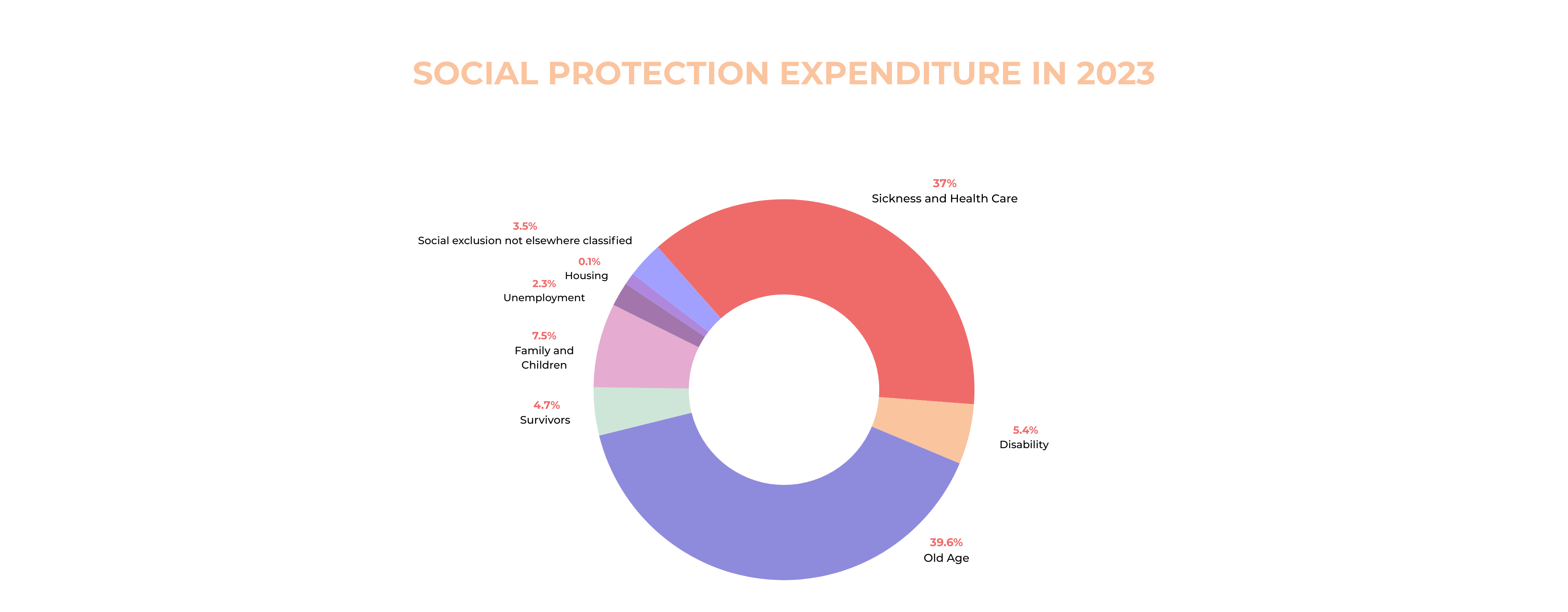
Slovenia’s 2023 total social protection expenditure was €14,800 million, of which:
- Social benefits: €14,611 million. Of these:
- Sickness and health care: €5,399 million.
- Disability: €782 million.
- Old age: €5,790 million.
- Survivors: €686 million.
- Family and children: €1,096 million.
- Unemployment: €331 million.
- Housing: €21 million.
- Social exclusion not elsewhere classified: €507 million.
- Administration costs: €178 million.
- Other expenditure: €11 million (Source: Statistical Office).
Social Services Coverage
Social Services Workforce
In Slovenia, centres for social work employ professionals from various fields, including social workers, psychologists, legal experts, and others. In 2024, the following number of positions of professional workers (including social workers) were occupied as follows:
- For the implementation of regular activities: 1,257.66.
- For the implementation of crisis accommodation: 82 (Source: Ministry of Labour, Family, Social Affairs and Equal Opportunities – confidential).
Long-term Care Services for Older People
Population aged 65+
As of 1 January 2024, 21.8% of the population or 462,512 people were aged 65 and over (Source: Eurostat).
In 2024, 38.9% of the population aged 65+ had some or a severe level of activity limitation (Source: Eurostat).
In 2022, 74,283 people of all ages received long-term care. Of these:
- 38.3% (28,473) received care at home.
- 30.6% (22,735) received care in institutions.
- 30.1% (22,357) received only cash benefits to cover care services.
- 1% (718) received day care (Source: Statistical Office).
At the end of 2024, approximately 19,500 people aged 65+ needed to access residential care. Of these, between 2,000 and 3,000 were estimated to require urgent admission (Source: Association of Social Institutions of Slovenia – confidential).
Residential care facilities
As of 1 January 2025, 15,772 places were available for older people in public care homes and facilities for adults with special needs, which also accommodate some older people. An additional 6,636 places were provided by private residential care homes operating through a public contract. Although privately run, these facilities are required to comply with the same legal standards as publicly managed institutions.
As of 31 December 2023, 19,143 older people lived in residential care homes and institutions for adults with special needs.
The usual waiting period for accessing residential care ranges from one to three months. However, it can sometimes be as short as a week or two, while in some care homes the waiting time can be a year or more, especially in cases where a single room is requested in a secure unit for people with dementia (Source: Association of Social Institutions of Slovenia – confidential).
Day care centres
In 2024, day care centres for people aged 65+, which operate as part of residential care homes, offered 819 places in publicly funded institutions and 56 places in private facilities operating through a public contract (Source: Association of Social Institutions of Slovenia – confidential)
The number of older people enrolled in publicly funded day care centres for older people is not available.
Home care services
In 2022, 28,473 older people received long-term care at home (pomoč na domu) (Source: Statistical Office).
As of 31 December 2023, an average of 14.92 hours of home help was provided per user per month. (Source: Social Protection Institute of the Republic of Slovenia – confidential).
Personal assistants
The Personal Assistance Act stipulates that a person may be eligible for personal assistance if they are between 18 and 65 years of age. However, if a person has exercised the right to personal assistance before reaching the age of 65, they may remain entitled to personal assistance even after exceeding this age limit.
As of 1 January 2024, 369 older people accessed a publicly funded personal assistant (Source: Ministry of Labour, Family, Social Affairs and Equal Opportunities – confidential).
Telecare services
Telecare services are now offered by private companies (not part of the public system and public financing), from which users can choose.
Reforms
In 2021, Slovenia adopted the Long-term Care Act, which has already undergone several amendments, with further changes currently in preparation. New long-term care benefits came into effect on 1 July 2025, including home care services, telecare services, and rehabilitation and support for independent living. From this date, employers, employees, and pensioners have also begun contributing to the long-term care insurance system.
Long-term Care Services for Adults with Disabilities
Population aged 18+ with disabilities
In 2024, 14.9% of the population aged 16-64 had some or a severe level of activity limitation (Source: Eurostat).
Residential care facilities and day care centres
No data available.
Home care services
As of 31 December 2023, 403 adults with disabilities received home care (pomoč na domu) (Source: Social Protection Institute of the Republic of Slovenia – confidential).
Personal assistants
As of 1 January 2024, 3,823 people with disabilities aged 18-64 accessed a publicly funded personal assistant (Source: Ministry of Labour, Family, Social Affairs and Equal Opportunities – confidential).
Telecare services
Telecare services are now offered by private companies (not part of the public system and public financing), from which users can choose.
Child Protection
In 2024, the following number of children were placed in alternative care:
- Foster care: 745 (201 of whom with relatives) (December 2024).
- Centres for the upbringing and education of children and adolescents with emotional and behavioural difficulties and disorders (strokovni centri): 528 (September 2024). These centres are specialised public institutions established to provide comprehensive, interdisciplinary support for children and adolescents who exhibit severe emotional and behavioural difficulties and are at risk of exclusion from regular educational environments.
- Crisis centres (krizni centri): 62 (December 2024). Crisis centres are institutions that provide short-term safe accommodation and psychosocial support for children and adolescents who are in crisis, at risk, or victims of abuse or neglect (Source: Ministry of Education; Ministry of Labour, Family, Social Affairs and Equal Opportunities – confidential).
Domestic Violence Support Services
Women experiencing domestic violence
In 2022, women represented 91% of intimate partner violence victims (797 out of 872) and 73% of domestic violence victims (2,052 out of 2,822) recorded by the Slovenian police (Source: EIGE).
Women receiving support from domestic violence support services
In 2024, the centres for social work handled 1,913 victims of domestic violence, 1,555 of whom were females (including 157 minors) (Source: Ministry of Labour, Family, Social Affairs and Equal Opportunities – confidential).
Victims who turn to centres for social work are offered a variety of assistance measures, complemented by services delivered by non-governmental organisations.
Emergency accommodation centres
In 2024, there were 293 places in emergency accommodation centres for women (and their children) fleeing domestic violence (Source: Ministry of Labour, Family, Social Affairs and Equal Opportunities – confidential).
Minimum Income Schemes
People who cannot ensure material security due to circumstances beyond their control can access the following benefits, regulated by the Act on the Exercise of Rights from Public Funds and the Social Assistance Benefits Act:
- Financial social assistance (denarna socialna pomoč): it provides beneficiaries with funds to meet their basic living needs for a specific period of time. Eligibility is determined based on income per person not exceeding the legally prescribed income threshold, and the amount depends, among other factors, on the number of family members, income, assets, savings, and provided care.
- Income support (varstveni dodatek): it provides beneficiaries with funds to cover living expenses incurred over an extended period, which are not expenses for meeting basic living needs. Persons permanently unemployable, permanently incapable of work, or unemployed women aged 63+ or men aged 65+ are entitled to income support if their income or their family’s own income does not exceed the threshold for the care allowance.
Furthermore, individuals or families who, due to circumstances beyond their control, find themselves in a situation of material hardship or who incur extraordinary expenses related to subsistence that their own income cannot cover, can access emergency financial social assistance (izredna denarna socialna pomoč). Recipients are obliged to use the received assistance for the purpose for which it was granted and must provide proof of the use of funds to the social work centres.
In 2024, there were 73,599 recipients of financial social assistance or income support, benefitting in total 107,656 people (Source: Ministry of Labour, Family, Social Affairs and Equal Opportunities – confidential).
Housing and Homelessness Support
Housing support allowances
The Housing Act foresees a rent subsidy (subvencioniranje najemnine), intended for tenants of rented dwellings who do not have sufficient funds to cover their rent costs and who meet the income threshold. The calculated subsidy amount is deducted from the tenant's rent by the landlord, and the authority reimburses this amount to the landlord. The subsidy is granted for a period of one year or for the duration of the lease agreement if it is shorter than one year.
Homeless people
In 2022, there were 3,545 homeless individuals, representing 0.17% of the total population. This figure included only people in emergency accommodation (e.g., shelters) and accommodation for the homeless (e.g. hostels and women’s refuges), but not people living rough, people living in institutions, people living in unconventional dwellings, or people staying with family/friends (Source: OECD).
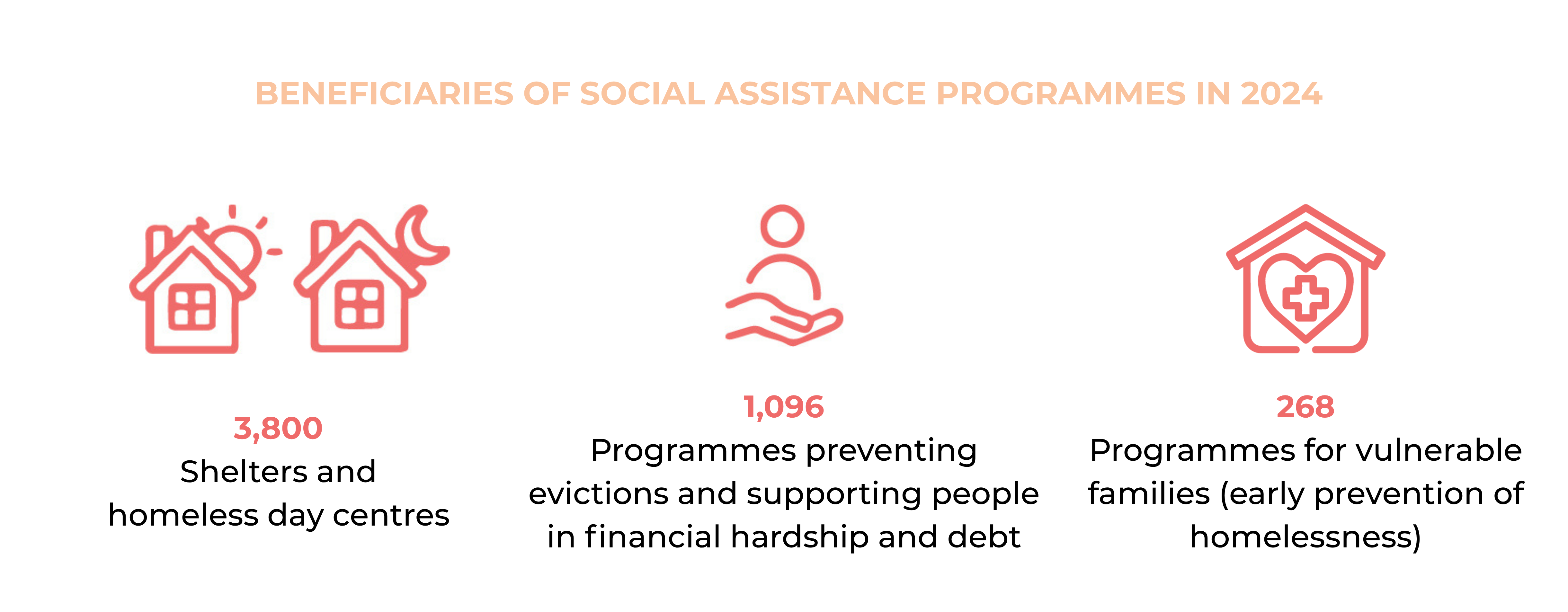
In 2024, the following social assistance programmes recorded the following number of service users:
- Shelters and homeless day centres: 3,800.
- Programmes preventing evictions and supporting people in financial hardship and debt: 1,096.
- Programmes for vulnerable families (early prevention of homelessness): 268 (Source: Ministry of Labour, Family, Social Affairs and Equal Opportunities – confidential).