
Recommendation
Ireland should strengthen the quality, regulation, and oversight of children's residential care, ensuring that children's best interests always take precedence. It should increase the capacity of public and non-profit provision and ensure that all residential care services are subject to consistent mandatory inspection, effective enforcement, and clear consequences for non-compliance.
Social Services Legislation
Right to access social services
People’s access to social services is recognised through sector-specific legislation, such as the Disability Act 2005 and the Child Care Act 1991.
Article 45 of the Constitution of Ireland outlines the principles of social policy, intended to guide the Irish parliament, stating that “the State shall strive to promote the welfare of the whole people by securing and protecting as effectively as it may a social order in which justice and charity shall inform all the institutions of the national life”.
Furthermore, the Social Welfare Consolidation Act 2005 establishes entitlement to particular social benefits.
Definition of social services
Ireland has no single, universally agreed-upon definition of social services in its legislation.
National social services catalogue
Ireland has no official catalogue of social services available at the national level. The Department of Social Protection manages an online collection of social welfare schemes and services, with each page explaining the nature of the scheme or service, eligibility requirements, and the application process. This, however, is not a comprehensive list.
National social services strategic plan
Ireland has no single national strategy covering all social services. Social services are instead addressed through separate national plans for specific sectors, including the following:
- The Health Service Executive’s National Service Plan 2025, covering services for older people, primary care and enhanced community care, virtual care, mental health services, social inclusion, and disability services.
- The Child and Family Agency (Tusla)’s Corporate Plan 2024-2026, covering alternative care, education support services, domestic and gender-based violence supports, adoption and birth tracing services, child protection, welfare, and family support services.
Responsibilities for social services
Responsibilities for social services are shared across several national departments and agencies:
- The Department of Children, Disability and Equality does not directly provide services, but is responsible for policy and funding in these areas and oversees the Child and Family Agency (Tusla).
- The Department of Health is responsible for health policy and funds the Health Service Executive (HSE), which provides health and social care services, including for older people and people with disabilities.
- The Department of Housing, Local Government and Heritage oversees housing policy.
- The Department of Social Protection administers social welfare schemes and services (Source: Citizens Information).
- The Health Information and Quality Authority (HIQA) sets standards and inspects and reviews health and social care services, although some residential care services, such as private children’s residential care services, fall outside its remit and gaps remain in its sanctioning powers.
- CORU regulates health and social care professions.
Ireland also has three regional assemblies, which coordinate overall strategic planning and development, including within EU funding, and 31 local authorities, responsible for a range of local services, including providing and maintaining social housing (Source: Citizens Information).
Social Services Financing
As of 1 January 2025, Ireland's population was 5,440,278 people (Source: Eurostat).
In 2025, the country’s gross domestic product (at market prices) reached €602,440.9 million (Source: Eurostat).
Ireland’s 2025 total expenditure was €129.9 billion, shared as follows:
- Social protection: €27.4 billion, of which:
- Illness, disability, and carers: €6.22 billion.
- Children: €3.04 billion.
- Supplementary payments, agencies, and miscellaneous services: €977 million.
- Working age income supports: €4.20 billion.
- Working age employment supports: €685 million.
- Administration: €762 million.
- Non-contributory state pensions: €1.34 billion.
- Contributory state pensions, and widows/widowers/surviving civil partners’ contributory pensions and death benefits: €10.17 billion.
- Health: €26.0 billion, of which:
- HSE health and social care: €2.37 billion.
- Long-term residential care: €1.27 billion.
- Housing: €9.7 billion.
- Education: €12.7 billion.
- Transport: €4.1 billion.
- Justice: €6.2 billion.
- Debt servicing, EU payments: €20.7 billion.
- Additional departments: €22.9 billion (Source: Department of Public Expenditure, Infrastructure, Public Service Reform and Digitalisation).
Social Services Coverage and Policies
Social Services Workforce
The social work profession is regulated by CORU, Ireland’s multi-profession regulator, under the Health and Social Care Professionals Act 2005. Only those registered with CORU can legally use the title of social worker. Registration requires meeting specific educational requirements, complying with a code of professional conduct and ethics, and maintaining continuing professional development.
As of 30 June 2025, 5,757 social workers and 2,335 social care workers were registered with CORU (Source: CORU).
Overall, in the fourth quarter of 2025, there were 393,700 employees in human health and social work activities (Source: CSO).
At the end of 2025, Tusla employed 5,661 full-time equivalent (FTE) staff, of which:
- 1,731.30 social workers (30.6%).
- 1,421.56 social care workers (25.1%) (Source: Tusla).
As of December 2025, the HSE employed 994 FTE social workers and 3,414 FTE social care workers. (Source: HSE). The remaining social workers are employed across voluntary agencies, the Probation Service, and the Defence Forces.
Long-term Care for Older People
As of 1 January 2025, 15.7% of the population, or 853,555 people, were aged 65 and over (Source: Eurostat).
In 2025, 36.9% of the population aged 65+ reported some or severe self-perceived long-standing activity limitation (Source: Eurostat).
Residential care
At the end of 2025, there were 32,408 places across 545 registered nursing homes. Nursing homes are owned and operated by a number of legal entities, including the HSE, HSE-funded bodies under sections 38 and 39 of the Health Act 2004, and private providers. The available places were shared as follows:
- 5,235 by the HSE.
- 1,075 by HSE-funded bodies.
- 26,098 by private providers (Source: HIQA).
The HSE Nursing Homes Support Scheme (Fair Deal) provides means-tested state support towards long-term residential care costs following a care needs assessment and a financial assessment. The average waiting time for an application to be approved is four to six weeks (Source: FairDealAssist).
As of September 2025, Fair Deal supported about 24,000 people, 80% of whom were supported in private nursing homes, with the remainder in public HSE-run facilities (both systems are funded through Fair Deal)(Source: Oireachtas).
Day care
As of the second quarter of 2025, there were 313 HSE and HSE-funded day centres operating across the country, providing community-based support to approximately 15,600 older people (Source: Oireachtas).
The National Meals on Wheels Network provides healthy meals directly to older people's homes. In 2025, 317 HSE-funded providers delivered over 2.8 million meals to 228,000 people nationwide (Source: National Meals on Wheels Network).
Home care and personal assistance
Older people who need support to live independently usually receive this through the HSE Home Support Service, a discretionary service accessed based on a care needs assessment, available resources, and competing demands. The average waiting time for an application to be approved is four weeks, and the average home care package is 7 hours per week, provided by the HSE or an external provider approved by the HSE (Source: HCCI).
The HSE is rolling out the International Resident Assessment Instrument (interRAI), a single, evidence-based tool that helps HSE workers identify older people's care and social support needs. However, its implementation remains significantly behind target: only 4,656 interRAI assessments were completed in 2025 against a national target of 18,100 (Source: Department of Health).
In 2025, the Home Support Service delivered 26.7 million hours of home support to 60,100 clients. 68% of these hours were delivered by independent providers. A further 5,600 people were on a waiting list (Source: HCCI).
Telecare
The Seniors Alert Scheme, funded by the Department of Rural and Community Development and the Gaeltacht and administered by Pobal, supports people aged 65+ by providing them with a monitored personal alarm so they can continue living securely at home. In 2025, over 17,700 applications were approved (Source: Oireachtas).
Reforms
In February 2025, the government announced the commencement of Section 16 of the Health (Miscellaneous Provisions) (No. 2) Act 2024, signed into law in July 2024. Section 16 gives the Chief Inspector of Social Services in HIQA new enforcement powers to issue compliance notices to providers of residential care for older people and people with disabilities when they are non-compliant with the Regulations (Source: Department of Health).
Strategies
Ireland’s National Positive Ageing Strategy dates from 2013, although subsequent strategies and policy frameworks address dementia, housing for older people, and universal health care.
Furthermore, the National Policy Framework for Adult Safeguarding for the Health and Social Care Sector, published in December 2025, sets out an ambitious programme of policy and legislative measures to support every adult who interacts with a health or social care service and may be at risk of abuse.
Long-term Care for Adults with Disabilities
In 2025, 17.3% of the population aged 16-64 reported some or severe self-perceived long-standing activity limitation (Source: Eurostat).
In 2025, 38,288 adults were registered with the National Ability Supports System. The most frequently reported primary disability type was intellectual disability (51%), followed by neurological disability (22%) and autism (10%) (Source: HRB).
Residential care
As of March 2026, the HSE, together with approximately 90 service providers, provided 8,911 specialist disability residential places to people with disabilities (Source: Oireachtas).
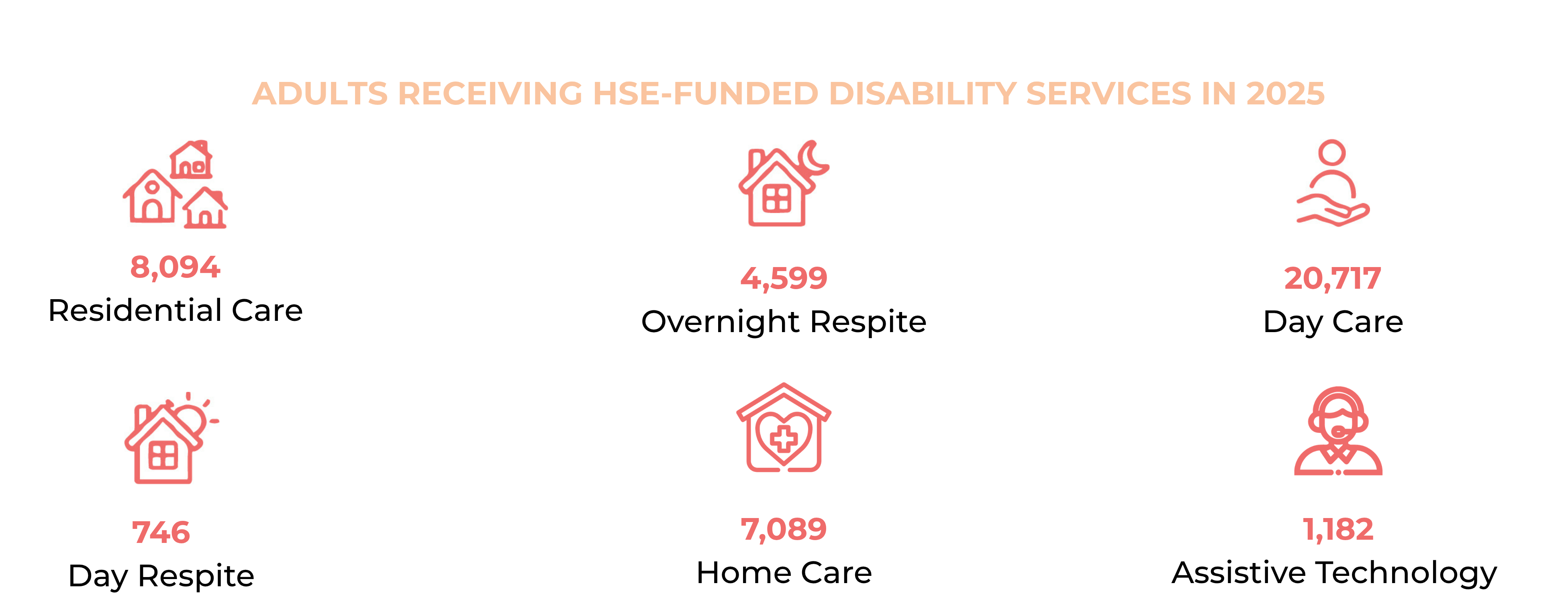
In 2025, 8,340 people, including 8,094 adults, were recorded as living in HSE-funded disability residential care. A residential house in the community was the most common residential setting (77%), followed by campus-based accommodation (19%) (Source: HRB).
Furthermore, 6,021 people, including 4,599 adults, accessed overnight respite, with adults averaging 17 nights (Source: HRB).
Day care
In 2025, 20,717 adults accessed 21,223 HSE-funded disability day services, including:
- 19,390 day programmes.
- 1,833 rehabilitative training services (Source: HRB).
Furthermore, 1,951 people, including 746 adults, accessed 1,986 day respite places (Source: HRB).
Home care and personal assistance
People with disabilities who need support to live independently usually receive this through the HSE-funded assisted living services. In 2025, 8,613 people, including 7,089 adults, received 8,850 assisted living services, including:
- 6,595 home support services.
- 2,255 personal assistant services (Source: HRB).
In 2025, an estimated 4,249,992 home support hours and 1,870,938 personal assistance hours were delivered to people with disabilities (Source: Department of Health).
Telecare
In 2025, 24,222 adults received at least one support service from either a multidisciplinary team or a specialised disability service. This includes 1,182 adults with a primary physical or sensory disability who received assistive technology (Source: HRB).
Reforms
No major reforms reported.
Strategies
Sharing the Vision: A Mental Health Policy for Everyone aims to strengthen mental health services and supports across a broad continuum, from mental health promotion to specialist mental health delivery, during 2020-2030. This document is accompanied by an implementation plan, the latest covering 2025-2027.
The National Human Rights Strategy for Disabled People 2025-2030 outlines the government’s framework to advance the human rights of people with disability across five key pillars: inclusive learning and education; employment; independent living and active participation in society; wellbeing and health; transport and mobility. The strategy is supplemented by an action plan every two years, the first one covering 2025-2026.
This new strategy complements the existing Action Plan for Disability Services 2024-2026, which outlines actions to achieve three key objectives: providing better access to services; maximising the impact of service delivery through strategic changes; achieving better planning and management through improved information and systems.
Child Protection
In 2025, Tusla received 106,444 referrals, most of which were for welfare concerns (55.5%), followed by emotional abuse (19.6%), physical abuse (11.2%), neglect (6.8%), and sexual abuse (5.9%). The type of concern was not recorded for the remaining 0.9% (Source: Tusla).
At the end of December 2025, 23,612 cases were open with Tusla. Of these, 77% (18,214) were allocated to a case worker and 23% (5,398) were awaiting allocation (Source: Tusla).
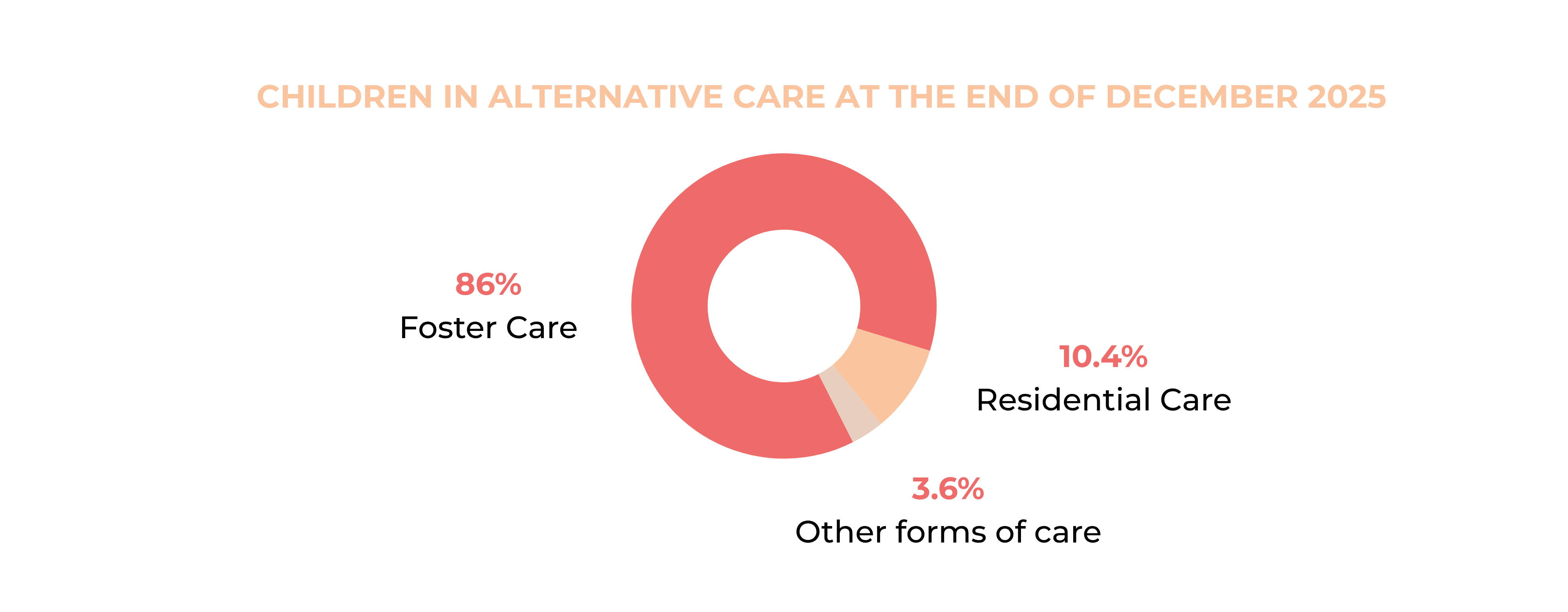
At that time, 5,879 children were placed in alternative care. Of these:
- 5,058 were in foster care (general and relative).
- 609 were in residential care (general and special).
- 212 were placed in other forms of care, including at home under a care order, in a detention centre, disability unit, mental health unit, drugs/alcohol rehabilitation unit, hospital, special emergency arrangement, supported lodgings, etc.
Of those in alternative care, 1,130 children (19%) were in placements with private providers, as follows:
- 609 in foster care.
- 415 in residential care.
- 106 in other forms of care (Source: Tusla).
Reforms
The Child Care (Amendment) Bill 2025 amended the Child Care Act 1991 to strengthen child protection, welfare, and agency cooperation. Key features include giving the National Review Panel a statutory footing, introducing legal duties for interagency cooperation (Tusla, HSE, police), and placing the child's best interests as a paramount consideration (Source: Gov.ie).
Strategies
The National Policy Framework for Children and Young People 2023-2028 sets out actions to achieve five national outcomes for all children and young people: being active and healthy; achieving in learning and development; being safe and protected from harm; having economic security and opportunity; being connected, respected, and contributing to their world.
This new framework complements the existing First 5: A Whole-of-Government Strategy for Babies, Young Children and their Families 2019-2028, Ireland's national ten-year strategy for improving the lives of babies and young children from the antenatal period to age five.
Domestic Violence Support
Women experiencing domestic violence
In 2025, the Irish police recorded 52,666 incidents of domestic abuse and 67,506 domestic abuse-related contacts (Source: RTÉ; An Garda Síochána).
Women’s Aid is a national organisation working to prevent and address the impact of domestic violence and abuse against women and their children. In 2025, the organisation recorded 37,790 contacts with its phone helpline and face-to-face support services, 62,275 disclosures of domestic abuse (57,520 against women and 4,755 against children), and 24,652 referrals, information provision, and advocacy by the helpline and regional services support workers (Source: Women's Aid).
Emergency accommodation centres
Safe Ireland National Social Change Agency is a network of 37 domestic violence refuge and support services across Ireland. A one-day census conducted on 28 January 2026 identified 172 refuge units (10 of which were unavailable), with capacity to accommodate 172 women and 593 children, as well as 56 safe homes and five transitional homes.
At that time, 850 adults and 324 children received support from specialist domestic violence services, 162 women and 93 children or dependent adults were residing in refuge accommodation, and 1,872 women had been turned away over the previous six months because of insufficient refuge capacity, lack of safe accommodation, or staffing/resource constraints (Source: Safe Ireland).
The government has committed to doubling domestic violence accommodation capacity in Ireland by the end of 2026 from 141 to 282 family units (Source: Oireachtas).
Reforms
In April 2025, a formal legislative process began for what became the Guardianship of Infants and Child Care (Amendment) Act 2026, signed into law on 21 July 2026. Known as ‘Valerie’s Law’, it introduced guardianship safeguards for children in cases where a parent kills the other parent.
Strategies
The Zero Tolerance: Third National Strategy on Domestic, Sexual and Gender-Based Violence 2022-2026 provides the national policy framework across prevention, protection, prosecution, and policy coordination. The strategy is implemented through a series of implementation plans, the latest covering 2025-2026. Since 2024, Cuan, Ireland's statutory agency for tackling domestic, sexual, and gender-based violence, has been responsible for coordinating the strategy’s implementation.
Minimum Income Support
Ireland’s minimum income and unemployment support system includes the following benefits:
- Jobseeker’s Pay-Related Benefit (JPRB), for people who become fully unemployed on or after 31 March 2025 and have sufficient Pay-Related Social Insurance (PRSI) contributions.
- Jobseeker’s Benefit (JB), for people who qualify under PRSI rules but are not covered by the JPRB.
- Jobseeker's Allowance, for unemployed people who do not qualify for the JPRB or JB, or whose entitlement has ended, and who satisfy the means test.
- Supplementary Welfare Allowance, for people who do not have enough income to meet their needs or the needs of their family.
In 2025, the following number of people received the following benefits:
- Jobseeker’s Pay-Related Benefit: 31,920 people.
- Jobseeker’s Benefit: 17,247 people.
- Jobseeker’s Allowance: 107,131 people.
- Supplementary Welfare Allowance: 9,288 people (Source: Department of Social Protection).
Reforms
No major reforms reported.
Strategies
The Roadmap for Social Inclusion 2026-2030, the successor to the previous strategy covering 2020-2025, set the same target of reducing the national poverty rate to 2% or less.
Housing and Homelessness Support
Housing support allowances
The two main housing support allowances in Ireland are:
- Housing Assistance Payment, paid directly to the landlord by the local authority to cover the person’s rent. In turn, the person pays a weekly rent contribution to the local authority, based on their income and ability to pay. The person can take up full-time employment and still receive this benefit.
- Rent Supplement, for people living in private rented accommodation who cannot cover the cost from their own resources. Individuals do not qualify for Rent Supplement if they or their partner is in full-time employment.
In 2024, 53,742 households received the Housing Assistance Payment (Source: Department of Housing, Local Government and Heritage).
In 2025, 5,419 people received the Rent Supplement (Source: Department of Social Protection).
People experiencing homelessness
During the week of 22-28 December 2025, 16,734 people accessed homeless emergency accommodation managed by local authorities, including 11,546 adults and 5,188 children (Source: Department of Housing, Local Government and Heritage).
Reforms
No major reforms reported.
Strategies
Delivering Homes, Building Communities 2025-2030: An Action Plan on Housing Supply and Targeting Homelessness aims to accelerate the delivery of new homes and tackle homelessness, building on the progress made under Housing for All.