Recommendation
Lithuania should strengthen the implementation framework for essential community-based and preventive social services through needs-based financing, clearer minimum service availability standards for all municipalities, and systematic monitoring of unmet need, waiting times, coverage, and quality. Particular attention should be given to families at risk of poverty, people with disabilities, children, and people experiencing domestic violence and homelessness.
Social Services Legislation
Right to access social services
People’s right to access social services is recognised in Article 5 of the Law on Social Services.
Definition of social services
Article 3 of the Law on Social Services defines social services as measures aimed at preventing social problems and/or social risks for an individual, family, or community. Social services also assist an individual or family who, due to age, disability, social risk, or social problems, is partially or fully unable or lacks the capacity to independently care for themselves or their family and participate in society.
National social services catalogue
The Social Services Catalogue regulates the content of social services, including definitions, target groups, place of provision, duration and frequency, composition of services, categories of providers and specific features of service provision. It covers preventive social services, general social services, and special social services. Special social services include social support services (socialinė priežiūra) and social care services requiring more intensive or continuous assistance (socialinė globa), including day, short-term, and long-term social care.
National social services strategic plan
Lithuania does not have a standalone national social services strategic plan. Strategic objectives relevant to social services are incorporated into the National Progress Plan 2021-2030 and associated development programmes. These cover poverty and social exclusion, family and child support, disability inclusion, employment participation, and access to community-based services.
Responsibilities for social services
Strategic direction, funding, social security, and social insurance are the responsibility of national authorities, foremost the Ministry of Social Security and Labour.
Municipalities are the primary organisers and executors of social services. They manage four major administrative pillars: needs assessment, planning, organisation, and financing.
Acting as an independent regulatory body under the Ministry, the Social Services Supervision Department is tasked with supervision and evaluation.
The actual delivery of social services is decentralised across a diverse ecosystem of providers that must be properly accredited or licensed by the state, including municipal providers, state providers, NGOs, and other accredited/licensed providers as applicable.
Social Services Financing
As of 1 January 2025, Lithuania’s population was 2,890,664 people (Source: Eurostat).
In 2025, the country’s gross domestic product (at market prices) reached €84,258 million (Source: Eurostat).
Social services are financed through several channels, including the state budget, municipal budgets, targeted state grants, EU funds, and programme-based funding.
Lithuania’s 2025 total state budget expenditure was €23,100.9 million, of which €6,647.1 million was dedicated to social protection (Source: Ministry of Finance). This figure covers social protection expenditure broadly and should not be interpreted as expenditure specifically on social services.
Social Services Coverage and Policies
Social Services Workforce
Social work in Lithuania is subject to statutory qualification requirements, although social workers are not required to register with or obtain a professional licence from a national professional body.
The profession is regulated by the Descriptions of Qualification Requirements for Social Workers and Social Work Assistants, the Procedure for Professional Development of Social Workers and Social Work Assistants, and the Procedure for the Certification of Social Workers.
In 2023, almost 17,000 people were employed in social services across the country, as follows:
- Institutions funded by municipalities: 5,729.
- State social care homes: 1,696.
- Non-governmental organisations: 4,295.
- Centre of sign language interpreters: 114.
Of these employees, approximately 5,000 were social workers, distributed as follows:
- Institutions funded by municipalities: 2,712.
- Non-governmental organisations: 1,233.
- Health care: 634.
- State social welfare institutions: 350.
- Correctional facilities: 51.
- Refugee reception centres: 13.
- Child rights: 8 (Source: Ministry of Social Security and Labour).
Long-term Care for Older People
As of 1 January 2025, 20.9% of the population, or 603,510 people, were aged 65 and over (Source: Eurostat).
In 2025, 50.6% of the population aged 65+ reported some or severe self-perceived long-standing activity limitation (Source: Eurostat).
Residential care
At the end of 2025, 179 residential care facilities for older people (including state, municipal, private, and other care facilities) offered 13,106 places. At the end of 2024, 8,274 people lived in these facilities.
At the end of 2025, 38 independent living homes for older people and adults with disabilities (including public and private homes) offered 743 places. At that time, 663 people lived in these homes (Source: Official Statistics Portal).
Day care
As of 1 January 2026, 122 day care centres served 3,001 users. No information is available about their age and condition (Source: Ministry of Social Security and Labour – private correspondence).
In 2025, 21,900 older people received specifically social services in day centres (Source: Official Statistics Portal).
Home care
In 2025, 37,864 older people and people with disabilities received social services at home (socialinės paslaugos asmens namuose)(Source: Official Statistics Portal).
In 2025, 14,261 older people received a specific sub-category of home care involving assistance with daily living and household-related tasks (pagalba į namus)(Source: Ministry of Social Security and Labour – private correspondence).
An individual’s need for social services is determined on a case-by-case basis, taking into account the person’s level of independence and the opportunities to develop it or compensate for it through social services that meet their interests and needs.
The Social Services Catalogue specifies the duration of social service provision:
- Home care: up to 10 hours per week.
- Daytime social care in the person’s home:
- 11 to 25 hours per week.
- 11 to 40 hours per week for a person with a disability who has been determined to have a need for compensation for the costs of providing individual assistance at the first or second level.
Personal assistance
No national age-disaggregated data identified.
Telecare
No national data identified.
Reforms
Lithuania has been implementing a reform of long-term care services to integrate social care and health care services, improve access to home- and community-based care, develop mobile teams and long-term care day centres, and introduce digital solutions for care coordination. In 2025, Lithuania continued implementing these reform measures under its Recovery and Resilience Plan.
Strategies
Lithuania does not have a standalone national strategy specifically targeting older people with long-term care needs. Long-term care is addressed within broader national health, social, and recovery/resilience policy frameworks. In particular, Lithuania’s Recovery and Resilience Plan includes a long-term care reform aimed at developing and gradually implementing a sustainable model of integrated social and health care services.
Long-term Care for Adults with Disabilities
In 2025, 12.8% of the population aged 16-64 reported some or severe self-perceived long-standing activity limitation (Source: Eurostat).
At the end of 2025, 268,664 people in Lithuania had an established disability. Of these, 249,146 were adults (Source: Official Statistics Portal).
Residential care
At the end of 2025, 80 care institutions for adults with disabilities (including state, municipal, private, and other care institutions) offered 1,501 places. At that time, 1,478 people lived in these institutions.
At the end of 2025, 38 independent living homes for older people and adults with disabilities (including public and private homes) offered 743 places. At that time, 663 people lived in these homes, although age/disability-specific breakdowns for these residents are not available (Source: Official Statistics Portal).
Day care
As of 1 January 2026, 122 day care centres served 3,001 users. No information is available about their age and condition (Source: Ministry of Social Security and Labour – private correspondence).
In 2025, 25,600 adults with disabilities received specifically social services in day centres (Source: Official Statistics Portal).
Home care
In 2025, 37,864 older people and people with disabilities received social services at home (socialinės paslaugos asmens namuose)(Source: Official Statistics Portal).
In 2025, 11,918 adults with disabilities received a specific sub-category of home care involving assistance with daily living and household-related tasks (pagalba į namus)(Source: Ministry of Social Security and Labour – private correspondence).
Personal assistance
In 2025, 1,752 adults with disabilities received personal assistance (Source: Ministry of Social Security and Labour – private correspondence).
Personal assistance is provided based on an individual’s specific needs and there is no limit on the number of hours. On average, each person receives 600 hours of personal assistance per year, or about 50 hours per month.
Telecare
No national data identified.
Reforms
The 2024 disability reform is based on the principles of the United Nations Convention on the Rights of People with Disabilities and introduces a stronger focus on individual needs assessment, assistance coordination, accessibility, and inclusion.
Strategies
The Action Plan for Ensuring the Participation of People with Disabilities 2024-2026, together with ongoing deinstitutionalisation and long-term care reform measures, aims to strengthen community-based services, improve participation and accessibility, and support the transition from institutional care to community-based services. Furthermore, EU and state budget funding continues to support implementation of the Action Plan for the Transition from Institutional Care to Family- and Community-Based Services for People with Disabilities and Children deprived of Parental Care 2014-2023 with projects running until 2029.
Child Protection
Following a report of a possible violation of a child's rights, child protection specialists assess the child's situation. Where ongoing support is required, the case may be referred to local social services for case management.
As of 31 December 2025, 10,352 child protection cases were receiving case management services.
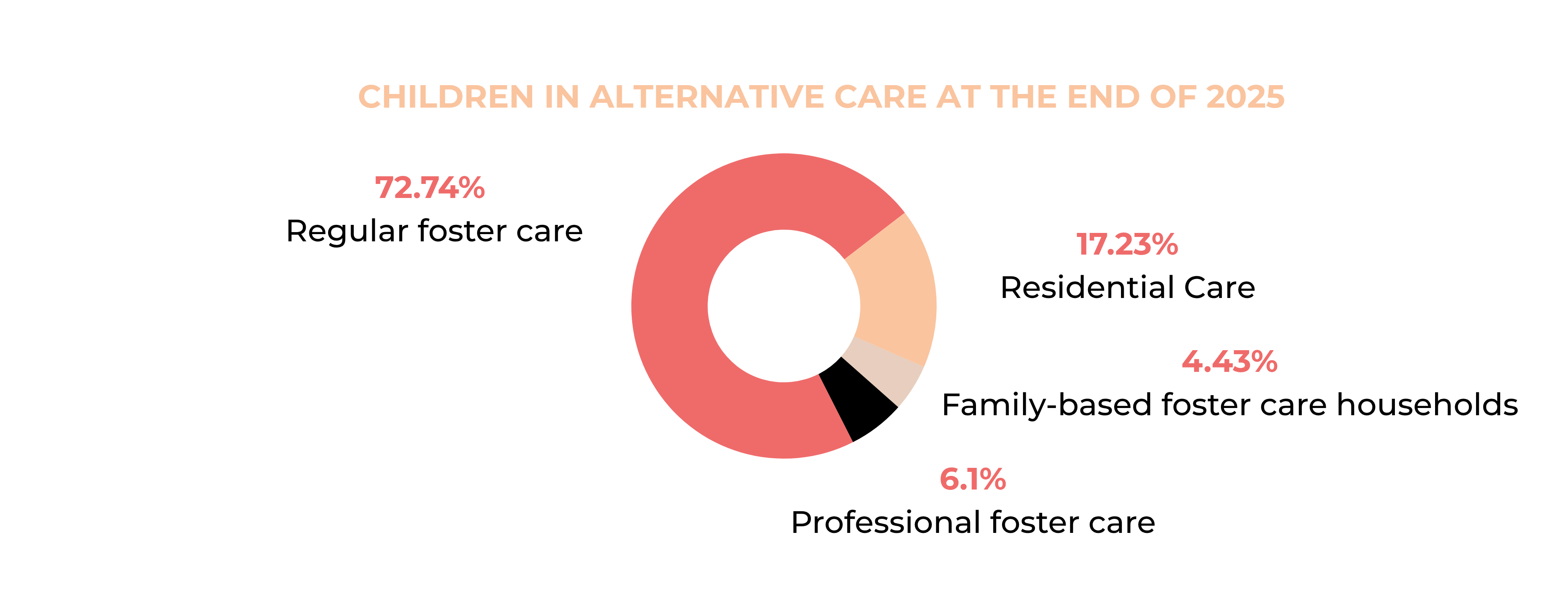
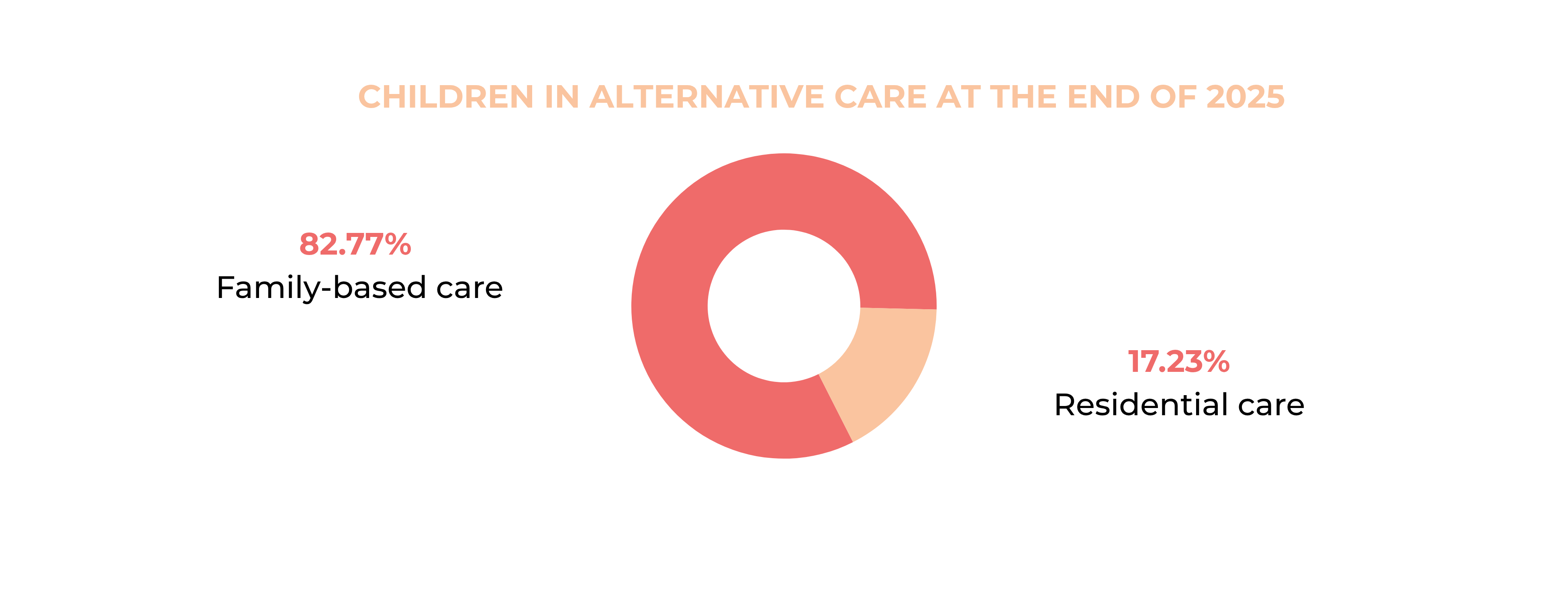
At the end of 2025, 5,774 children were in alternative care, of which:
- 4,486 under permanent guardianship.
- 1,288 under temporary guardianship (including 410 unaccompanied minors from Ukraine).
The type of care was as follows:
- Regular foster care (with foster carers or relatives): 4,171 children.
- Family-based foster care households (šeimynos)(households caring for a group of children): 256 children.
- Professional foster care (in foster care centres or with professional on-call caregivers): 352 children.
- Residential care (in community-based children's care homes): 995 children (Source: Ministry of Social Security and Labour – private correspondence).
Once a court determines that a child requires long-term alternative care and parental authority is restricted, the State Child Rights Protection and Adoption Service must submit a potential guardian to the court within 10 days. The selection of a suitable guardian is conducted by the Care Centre's matching commission. In practice, identifying and proposing a suitable long-term placement usually takes several weeks, with the overall waiting time largely depending on the court's workload and the scheduling of hearings (Source: Code of Civil Procedure).
Reforms
Lithuania's child protection system was structurally centralised in 2018 (Source: State Child Rights Protection and Adoption Service).
More recently, from 1 November 2024, people working with children became subject to a QR-code-based eligibility requirement intended to strengthen safeguards against sexual offences. Lithuania has also further developed specialised multidisciplinary assistance for children and families through its Barnahus activities.
Strategies
The Child Welfare Action Plan 2025-2027 aims to strengthen the country’s child welfare system, with a strong focus on community- and family-based services. Furthermore, the National Action Plan for the European Child Guarantee 2023-2030 translates the EU objectives into national measures to ensure access to key services for children in need.
Domestic Violence Support
Women experiencing domestic violence
In 2022, women represented 89% of intimate partner violence victims (3,485 out of 3,905) and 77% of domestic violence victims (4,603 out of 5,993) recorded by the Lithuanian police (Source: EIGE).
In 2025, there were 3,404 pre-trial investigations of domestic violence in which women were identified as victims. Pre-trial investigations are generally opened only when there are signs of physical violence. Therefore, this figure does not reflect the full extent of domestic violence experienced by women (Source: IRD).
Domestic violence support services
In 2025, 17,729 women received support from Specialised Complex Assistance Centres (specializuotos kompleksinės pagalbos centrai – SKPC), including information and consultation, specialised psychological and legal assistance, mediation, and personal accompaniment (Source: Department of Social Services Supervision).
Emergency accommodation centres
As of May 2022, 66 social service institutions had been granted the right to provide accredited intensive crisis intervention support (Source: Ministry of Social Security and Labour).
A national up-to-date figure for the number of places specifically in women’s crisis centres is not available.
Reforms
No major reforms reported.
Strategies
The Action Plan for the Prevention of Domestic Violence and the Provision of Assistance to Persons at Risk of DV, Persons who Have Experienced DV, and Persons Posing a Risk of DV sets out measures for 2024-2026 to reduce domestic violence by improving prevention, protection, and assistance.
Minimum Income Support
Lithuania’s main minimum income scheme is the means-tested social assistance benefit (socialinė pašalpa), which is part of the broader system of cash social assistance for low-income residents (piniginė socialinė parama nepasiturintiems gyventojams). This is targeted at low-income single persons and families and is administered by municipalities. Municipalities may also provide additional discretionary support in specific cases, in line with national legislation and local procedures.
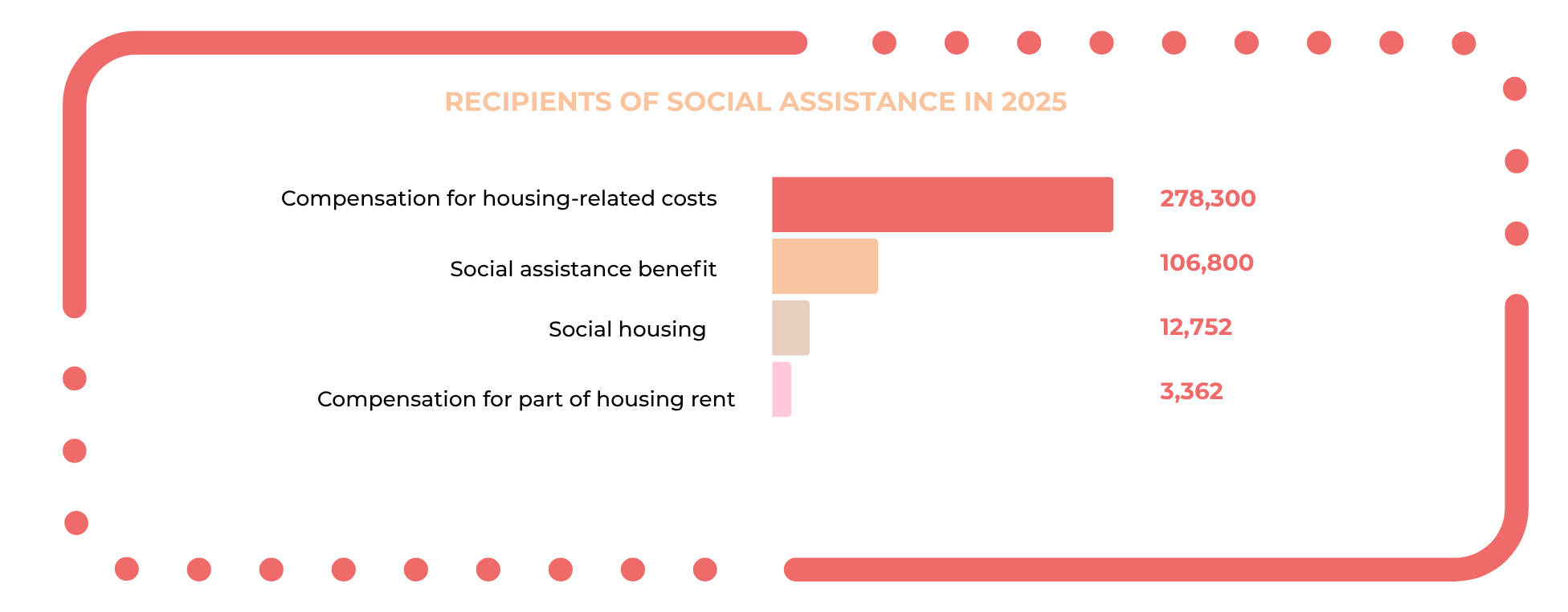
In 2025, on average, 61,200 people received the social assistance benefit each month, while the total unique number of recipients during the year was approximately 106,800 (Source: Ministry of Social Security and Labour).
Reforms
To create more favourable conditions for low-income residents to receive cash social assistance, the government adopted amendments to the Law on Cash Social Assistance for Low-Income Residents on 23 December 2025, which entered into force on 1 June 2026. These amendments aim to increase the accessibility and adequacy of cash social assistance, as well as incentives to integrate into the labour market. They introduce more favourable eligibility conditions for single parents and for families raising children with disabilities, ease conditions for employed persons, improve the granting of additional social assistance benefits after entering employment, revise asset assessment criteria, strengthen the empowerment of cash social assistance recipients to participate in employment promotion measures, and introduce other improvements.
Given that the existing financing model for cash social assistance, unchanged since 2012, has been insufficient for municipalities to ensure the provision of this support, the financing model for this autonomous municipal function will change from 2027 (Source: Ministry of Social Security and Labour – private correspondence).
Strategies
Lithuania does not currently have a standalone national anti-poverty strategy. Poverty reduction is mainly addressed through the broader National Progress Plan 2021-2030 and the development programmes coordinated by the Ministry of Social Security and Labour.
Housing and Homelessness Support
Housing support allowances
The cash social assistance system also includes compensation for housing-related costs, namely heating, drinking water and hot water costs (būsto šildymo, geriamojo ir karšto vandens išlaidų kompensacijos). This is targeted at low-income single persons and families and is administered by municipalities. Municipalities may also provide additional discretionary support in specific cases, in line with national legislation and local procedures.
In 2025, on average, 137,600 people received compensation for housing-related costs each month, while the total unique number of recipients during the year was approximately 278,300 (Source: Ministry of Social Security and Labour).
In addition, Lithuania provides housing support measures under the Law on Support for the Acquisition or Rental of Housing, including compensation for part of housing rent (būsto nuomos mokesčio dalies kompensacija) and access to social housing. These measures are administered by municipalities and are separate from cash social assistance, although they are also means-tested and targeted at low-income individuals and families.
In 2025, 3,362 households received compensation for part of housing rent. At the end of 2025, 12,752 households rented social housing (Source: Lithuanian Government).
People experiencing homelessness
Lithuania does not have a recent comprehensive national homelessness count covering all forms of homelessness. The latest internationally comparable figure was 4,317 people in 2022, but it covered only people in emergency accommodation (e.g., shelters) and accommodation for the homeless (e.g., hostels and women’s refuges), which substantially narrows the population measured (Source: OECD).
Reforms
No major reforms reported.
Strategies
Lithuania does not currently have a standalone national strategy to tackle homelessness.
The City of Vilnius, together with the Ministry of Social Security and Labour, the Vilnius Archdiocese Caritas, and the Vilnius City Council House, is undertaking the implementation of the Housing First program pilot project. This is the first initiative of its kind in Lithuania and will provide 10 apartments to people experiencing homelessness (Source: Made in Vilnius).