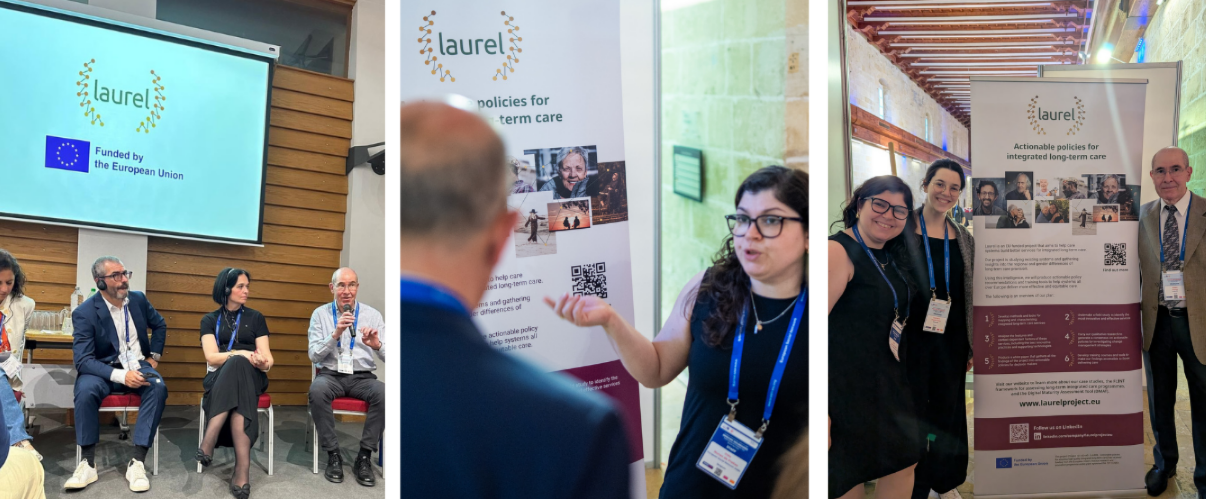
The LAUREL project was pleased to take part in the European Social Services Conference (ESSC) 2026 in Valletta, Malta, which brought together more than 950 delegates from across Europe and beyond to discuss the future of social services.
Under the conference theme "Bridging Boundaries – International Insights into Social Services", participants explored how social services can work across sectors, professions, and borders to respond to increasingly complex social challenges. Integrated long-term care was one of the topics that featured prominently throughout the event.
LAUREL contributed to the thematic panel discussion "Achieving Integrated Long-Term Care for Better Outcomes", where project coordinator Albert Alonso (FCRB-IDIBAPS) presented the project's ongoing work on integrated long-term care systems across Europe. The session brought together examples from Catalonia, Gipuzkoa, and Italy, offering different perspectives on how health and social care services can work more closely together to better support people with long-term care needs.
The presentation highlighted some of the emerging lessons from LAUREL's research. While approaches differ across countries and regions, many face similar challenges, including fragmented services, workforce shortages, funding pressures, and difficulties in coordinating support across health and social care systems. Discussions focused on practical solutions, such as strengthening coordination mechanisms, investing in the workforce, and ensuring that services are designed around people's needs and experiences.
Beyond the conference session, the LAUREL project was also featured at the Walking Practice Fair, where Inês Nunes de Freitas - Senior Membership and Project Officer at the European Social Network - had the opportunity to engage directly with conference delegates and present the project's work. The Walking Practice Fair created a valuable space for dialogue, with representatives from public authorities, social services organisations, research institutions, and civil society exchanging experiences and discussing common challenges related to the delivery of integrated long-term care across Europe.
These conversations highlighted the growing interest in integrated long-term care across Europe and confirmed the importance of sharing evidence and practical experiences between policymakers, practitioners, researchers, and people using services.
ESSC 2026 provided an excellent opportunity for LAUREL to share its work, gather feedback from stakeholders, and contribute to the wider discussion on how long-term care systems can become more integrated, person-centred, and sustainable. As the project progresses, these exchanges will continue to inform the development of recommendations aimed at supporting better long-term care outcomes across Europe.