
Agency is key to social inclusion of refugees. This is the core message stemming from the interviews conducted under the ECSILI - Empowering Communities Project to evaluate effectiveness of the inclusion model currently being piloted.
On World Refugee Day, social services are called to reflect upon what makes inclusion approaches effective, and what better way to do this than to listen to the voices of the people who should benefit from these policies, shifting perspective to them as an active subject rather than its object.
Individualised support as a means of empowerment
The first encounter with a new country’s bureaucracy can be startling and discouraging for people with little local language skills and limited understanding of their rights, obligations, and the labour market. Being pushed from one office to another can have a strong psychological toll on people, with effects on their motivation and psychological wellbeing.
This was the common thread among refugees interviewed for the ECSILI Project to learn more about the practical implications of the individualised counselling programme the Consortium has set up in Warsaw, Poland and Arad, Romania.
“I was alone and right now… I am not”, “we were scared at the beginning […] but now we are going ahead”, “it's like group of persons who are interested in supporting us to find a job”. These are some of the powerful statements stemming from the interviews, reinforcing how good, individualised case management has a positive impact on users’ lives.
The interviews highlighted how individualised support consisting of constant communication, providing a space for listening, and setting realistic objectives that can be followed up day-by-day does wonders for refugees’ confidence in their ability to find employment and psychological stability. Therefore, more than material support, the ECSILI approach emphasises empowerment and agency, restoring hope in adverse circumstances. Emblematic of this feeling is the testimony from one refugee who said that the individual counselling made her “brave enough” to go look for a job in unexpected places, considering her educational background.
On the other side of the coin
Although the Temporary Protection Directive provides the legal basis for the right of Ukrainian refugees to establish themselves in the EU, it does not automatically eliminate barriers for their meaningful inclusion. For example, it does not generate funds for local language classes which would increase their job opportunities, and it does not convince local employers that the administrative burden they take on to hire Ukrainian refugees will be worth it for them in the end.
As a result, while case managers with ECSILI can show refugees tools to improve their inclusion situation in their new country, they too are constrained by the policy circumstances they navigate. This poses a limit to what they can do for their clients.
Hence the importance of a community approach towards refugees’ social inclusion, involving relevant stakeholders in joint activities, and generating awareness to overcome mutual scepticism. This is an endeavour ECSILI has tried to pursue through the creation of Local Action Plans, bringing social and employment services as well as grassroots NGOs to collaborate together on refugees’ inclusion pathways. Nevertheless, 8 months to pilot this programme does not leave enough time to find the most optimal solutions and ways for meaningful involvement and collaboration, forcing implementing organisations to adopt a trial-and-error approach.
The power of agency and self-expression
As the ECSILI pilot comes to an end in July 2026, tied to the time-limited resources stemming from the ESF+ social innovation + programme, questions about the sustainability of the model linger, with the project’s stakeholders worrying about what the future holds for this model.
These questions become all the more pressing in the aftermath of the European Parliament’s approval of Deal on new EU rules on migrants return, prioritising toughening return policies as the mainstream approach to dealing with migration, a further step toward lowering refugees’ voices in the political arena.
Stories from refugees highlighting how individualised support allowed them to tap into their resilience and capabilities cannot remain unheard. Within this context, the words of Alfonso Lara Montero, Chief Executive Officer of the European Social Network resonate loud and clear: “personal stories are foundational to policy design in the field of social and labour market integration”.
ECSILI shows how agency and self-expression thus bear the power of getting refugees in touch with a version of themselves that felt buried beneath the stress of life lived in survival mode. On World Refugee Day, it is important to acknowledge this to help inform social and labour market integration policies.
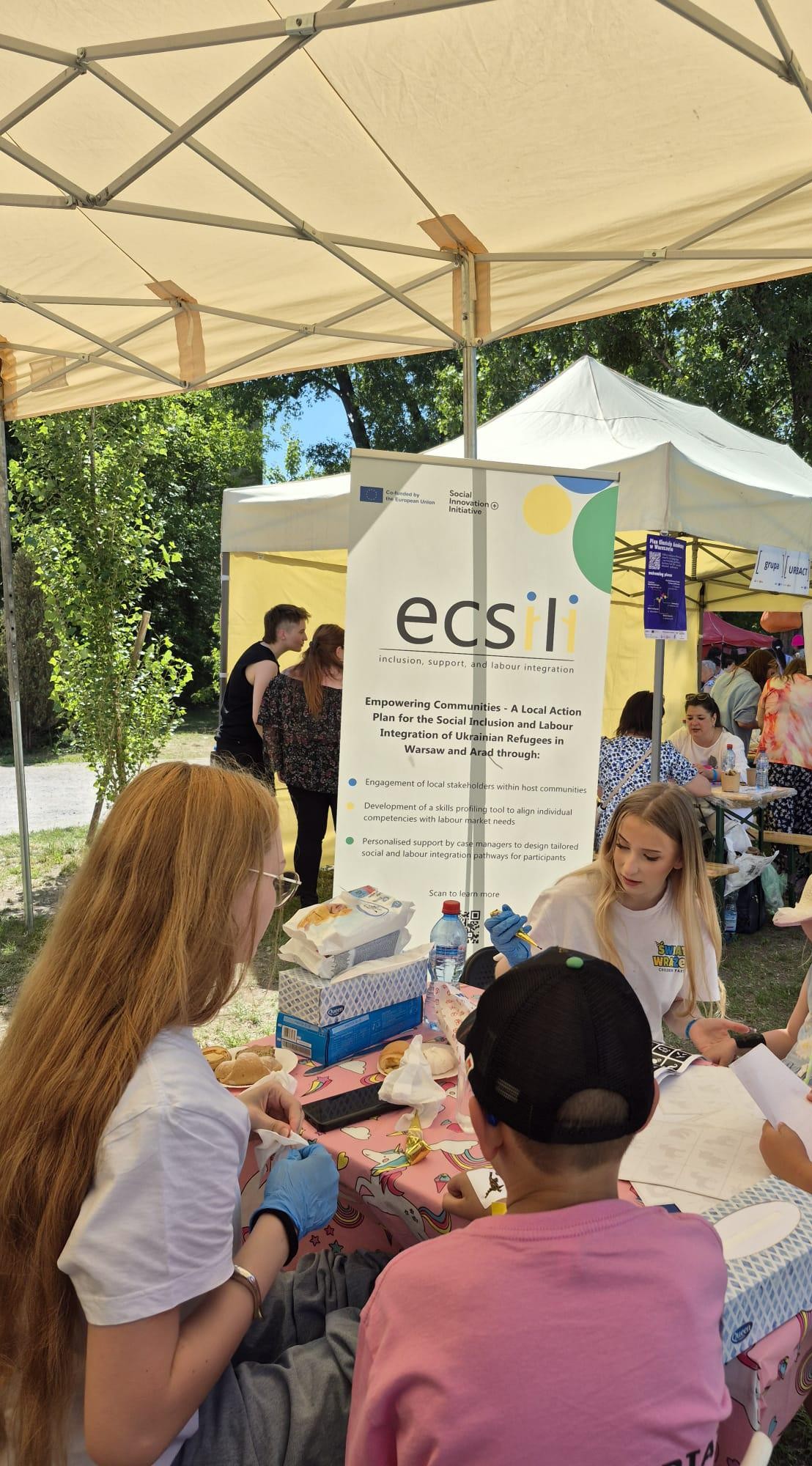
ECSILI was present at a picnic with refugees for the World Refugees Day in Warsaw, Poland.

Co-funded by the European Union. Views and opinions expressed are, however, those of the author(s) only and do not necessarily reflect those of the European Union or the European Social Fund Agency. Neither the European Union nor the Granting Authority can be held responsible for them.